Documentation Best Practices for MSPs Using Offshore Teams
There is a specific failure mode that catches MSP owners off guard when they first add an offshore technician. The engagement starts well — onboarding goes smoothly, the technician is competent and communicates clearly, the first few tickets are handled correctly. And then somewhere around week three or four, something goes wrong. A ticket for a client with an unusual network configuration gets handled incorrectly because the technician had no way of knowing about an exception that the senior local tech has carried in his head for eighteen months. Or a password reset for a client with custom MFA requirements gets botched because that requirement was never written down anywhere. Or an escalation that should have gone to you goes sideways because the escalation path was communicated verbally during onboarding and then forgotten.
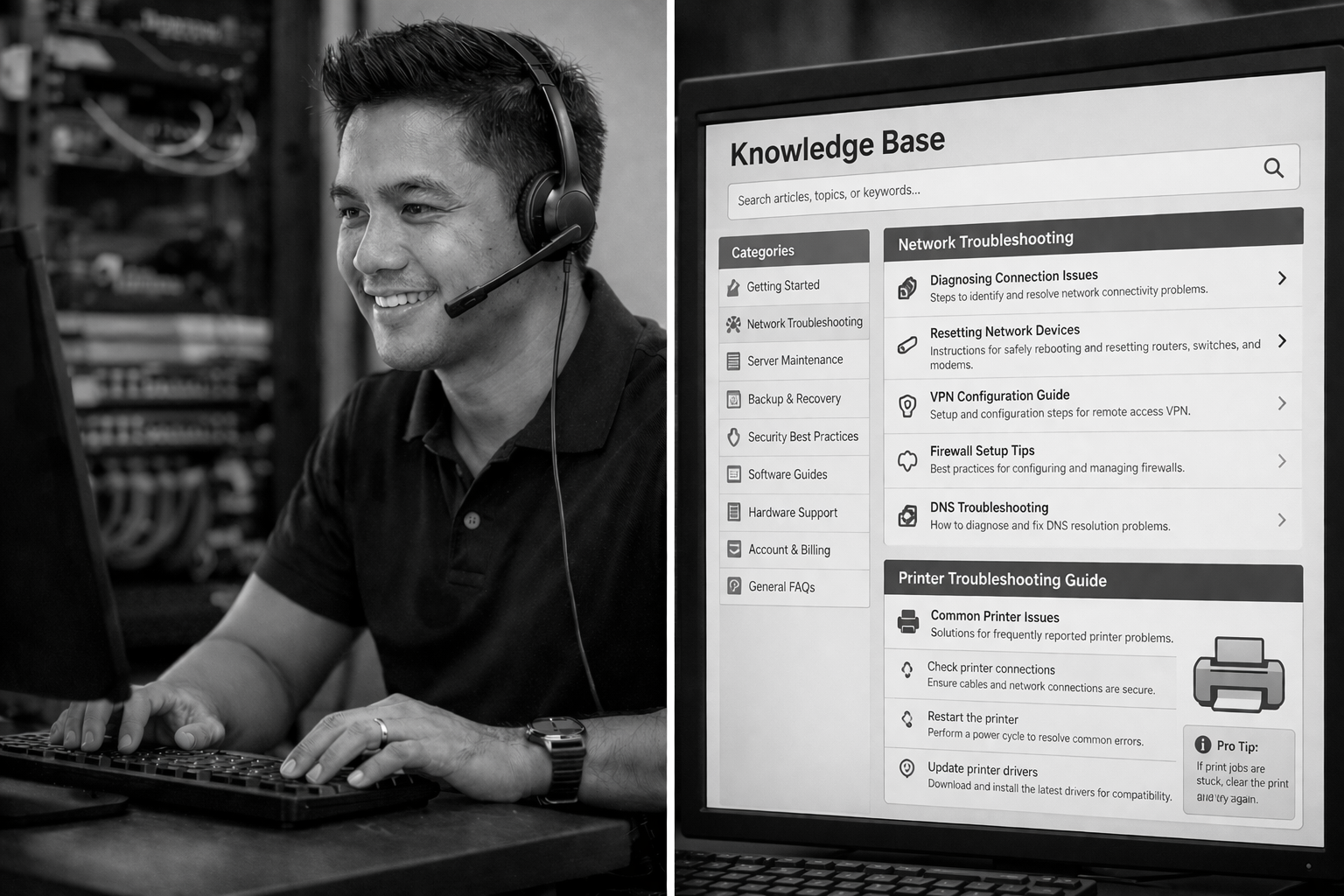
These are not offshore staffing failures. They are documentation failures that the offshore engagement simply makes visible — and that would have eventually caused problems with any technician, local or remote, who wasn't the person holding the tribal knowledge. The difference is that offshore technicians, working in a different time zone without the ability to lean over and ask a colleague, depend on written documentation far more completely than local staff who can fill gaps through proximity. Adding an offshore team member is therefore one of the most effective forcing functions available to an MSP owner for getting documentation right — because the gaps that were manageable before become impossible to ignore afterward.
Why Documentation Problems Are Worse Than Most MSPs Realise
The scale of the documentation problem in the MSP industry is not a matter of debate. Centrel Solutions' January 2026 analysis of the top MSP documentation challenges describes the core problem precisely: no engineer can realistically retain the details of 20–40 distinct client environments, and when documentation is weak or missing, technicians are forced to rely on guesswork, tribal knowledge, or ad-hoc messages to colleagues. This slows resolution times, increases the risk of mistakes, and creates single points of failure when only one person "knows" a particular client. The analysis identifies this not as a personnel problem but as a documentation problem — one that is entirely avoidable with the right structure in place.
The financial cost of leaving it unaddressed is significant. IT Portal's February 2026 research on MSP knowledge loss found that teams report cutting onboarding periods by 40–60% when comprehensive documentation is readily available — which means that the inverse, inadequate documentation, is extending onboarding timelines by that same margin and compounding it across every new hire cycle. When a senior technician leaves and takes their environment-specific knowledge with them, the replacement cost goes far beyond the $12,000 average technician replacement figure — it includes the months of institutional knowledge that cannot be bought back and must be painstakingly reconstructed from client records, ticket history, and whatever fragments remain in the outgoing technician's notes.
For MSPs managing offshore teams, the stakes are higher because the buffer of informal knowledge-sharing — walking over to ask a question, getting a quick verbal briefing — does not exist across a time zone gap. What your offshore technician cannot find in your documentation, they simply cannot know. This makes the quality of your documentation a direct ceiling on the quality of what your offshore engagement can produce.
The Two Categories of Documentation Every MSP Needs
MSP documentation falls into two categories that serve different purposes, and both need to be in place before an offshore technician can operate effectively. Understanding the distinction helps prioritize the documentation investment correctly.
Internal operational documentation is the documentation your team uses to run the support function itself. This includes standard operating procedures (SOPs) for routine tasks, escalation path definitions, tooling access guides, and the internal knowledge base of common issues and proven resolutions. This is the documentation that tells a technician — any technician, local or remote — how your MSP operates, what your standards are, and how to handle situations that fall within defined scope. V2 Cloud's MSP documentation guide frames internal documentation as the reference and foundation for efficiency: when properly maintained, it reduces response times, prevents costly mistakes, and enhances the overall client experience. Without it, every technician is improvising — and offshore technicians are improvising in the dark.
Client-specific environment documentation is the documentation that captures what is unique about each client: their network topology, their hardware inventory, their software stack, their specific configurations, their exceptions and quirks, their escalation contacts, and their historical issues. This is the documentation that allows a technician who has never worked with Client X to handle a Client X ticket competently without calling you. It is the documentation that transforms "you need to ask Dave" from an operational dependency into a knowledge base entry. For MSPs supporting 10, 20, or 40 clients, this documentation is the operational moat that protects service quality when staff turn over — and it is the category most consistently underdeveloped in practices that have relied on experienced local technicians to carry the knowledge personally.
The Documentation Framework That Makes Offshore Work
Building documentation from scratch feels overwhelming, particularly for MSP owners who are already operating at capacity. The practical approach is to build sequentially rather than comprehensively — starting with the highest-frequency, highest-impact items and expanding from there.
| Documentation Priority | What It Covers | Format | Build This First If... |
|---|---|---|---|
| Escalation paths | What triggers escalation, who receives it, how it's communicated, expected response time | Simple decision tree or table per severity tier | You are adding an offshore technician within the next 30 days |
| High-frequency L1 SOPs | Step-by-step resolution guides for your 10–15 most common ticket types | Numbered steps in your knowledge base tool, with screenshots where relevant | Your offshore technician will be handling tickets from day one |
| Client environment profiles | Network layout, hardware inventory, key contacts, known quirks, exceptions, and historical issues | Structured template per client, stored in IT Glue, Hudu, or equivalent | Your offshore technician will support multiple clients |
| Tooling and access guide | How to use your PSA, RMM, communication tools, and credential manager; what each system is for | Onboarding document with links to relevant tool documentation | Always — this should exist before any new hire, local or remote |
| Ticket notes standards | What constitutes a complete ticket note, what format to follow, what to include in escalation handoffs | One-page standard with examples of good and poor notes | You want escalation handoffs to arrive structured rather than raw |
The escalation path and high-frequency SOP categories are the minimum viable documentation set for an offshore engagement. Without them, your offshore technician cannot handle any ticket independently and cannot escalate any ticket cleanly — which means you're paying for a remote resource while still absorbing the full cognitive load yourself. With them, the technician can independently resolve the majority of L1 volume and hand off everything else as a structured, usable package.
The Tribal Knowledge Extraction Problem
The hardest part of building client environment documentation is that the information it needs to capture typically exists in the minds of one or two senior people — and extracting it requires deliberately interrupting those people during the time they are most busy. The Centrel Solutions analysis identifies this as one of the most persistent MSP documentation challenges: engineers who specialise in specific client subsets develop their own preferred ways of documenting things, producing a patchwork of styles, formats, and expectations. Some clients end up beautifully documented; others have nothing.
The practical approach that works for most MSPs is not a documentation sprint — sitting down to write everything at once — but a documentation-on-resolution practice. Every time a ticket is resolved that reveals something environment-specific, the technician who resolved it adds or updates the client profile entry before closing the ticket. This converts the existing workflow into a documentation engine rather than creating a separate documentation overhead. It requires discipline and a clear standard for what constitutes a documentable finding, but it produces a knowledge base that grows continuously rather than requiring a discrete project to build. NinjaOne's January 2026 guidance on building IT knowledge bases recommends assigning tip stewards — team members who review submitted knowledge weekly, de-duplicate, sanitize sensitive information, and verify accuracy before formally incorporating it into the knowledge base. That structure prevents the documentation from becoming a dumping ground and ensures what gets written down is accurate and reusable.
Tooling: What Experienced MSPs Use for Offshore-Ready Documentation
The tools used for MSP documentation matter, but not as much as having a consistent practice around a tool. The best documentation platform is the one your team will actually use and maintain. With that caveat stated, the tools that experienced MSPs consistently recommend for structured client environment documentation are IT Glue, Hudu, and Confluence — each offering searchability, version control, access controls, and integration with major PSA and RMM platforms. The NinjaOne platform also provides integrated documentation alongside its RMM functionality, which reduces context-switching for technicians who are already managing endpoints through the platform.
For offshore teams specifically, two tooling requirements are non-negotiable. The first is searchability — your offshore technician needs to be able to find the relevant client profile or SOP within seconds, not navigate a folder structure that made sense to whoever created it two years ago. Documentation that cannot be found quickly is documentation that will not be used. The second is access control — your offshore technician needs appropriately scoped access to the documentation relevant to their work, with sensitive credential and configuration information protected behind role-based permissions. This is not a trust issue; it is a security architecture issue that applies equally to any remote access arrangement, domestic or offshore.
How Good Documentation Changes the Offshore Engagement
The difference between an offshore engagement that struggles and one that performs well is almost entirely a documentation question after the first few weeks. A Filipino technician who has clear SOPs, a complete client environment profile, and a defined escalation path can handle a standard L1 ticket queue independently with minimal oversight. A technician without those resources — regardless of how competent they are — is constantly hitting walls that require interrupting you or a senior local team member to resolve.
This is the counterintuitive reality of offshore staffing: the investment that makes it work is not primarily in the technician. It is in the systems and documentation that allow the technician to operate autonomously. MSPs that build that documentation infrastructure — even in the minimal viable form described above — consistently report that their offshore engagement performs beyond initial expectations. MSPs that skip it consistently report frustration with the model, when the actual problem is the documentation debt they were already carrying. The Konnect first 90 days implementation guide covers how to sequence documentation development alongside offshore technician onboarding, so both progress in parallel rather than documentation becoming a blocker.
The side benefit — worth stating explicitly — is that documentation built for an offshore engagement benefits the entire operation. The SOPs that let your Filipino technician resolve a common ticket independently are the same SOPs that onboard a new local hire faster, reduce errors when a senior technician is unavailable, and protect you when a key team member leaves. The client environment profiles that let your offshore team handle a client confidently are the same profiles that demonstrate professionalism to clients, protect service continuity during staff transitions, and form the institutional knowledge base that makes your MSP more valuable as a business. Good documentation is not overhead. It is infrastructure.
Starting Where You Are
The documentation gap in most MSPs is not insurmountable — it just feels that way because the full scope of what needs to exist is visible and the time available to build it is not. The practical starting point is to choose the five clients your offshore technician will support first, document those five environments to the minimum viable standard in the table above, and build the high-frequency SOP library for the 10 most common ticket types across those clients. That is a finite, achievable project — and it produces an offshore engagement that works from the beginning rather than one that struggles for the first three months while documentation catches up.
If you're at the point of considering an offshore technician and documentation feels like a barrier, that is exactly the right conversation to have before the engagement starts rather than after.
📅 Book a 20-minute call: https://meet.brevo.com/konnectph
✉️ Email us: hello@konnect.ph
We help MSP owners structure the documentation foundation before day one so the offshore engagement performs from the start — not after a painful discovery period.
About the Author
Vilbert Fermin is the founder of Konnect, a remote staffing company connecting North American and Australian businesses with top Filipino talent. With deep expertise in IT support and remote team management, Vilbert helps MSPs access skilled technical professionals without the overhead of full-time domestic IT staff. His mission is to showcase Filipino excellence while helping businesses stay protected, productive, and competitive through strategic remote staffing.
Related Resources