How Canadian MSPs Are Solving the Technician Shortage with Offshore Helpdesk Support (2026)
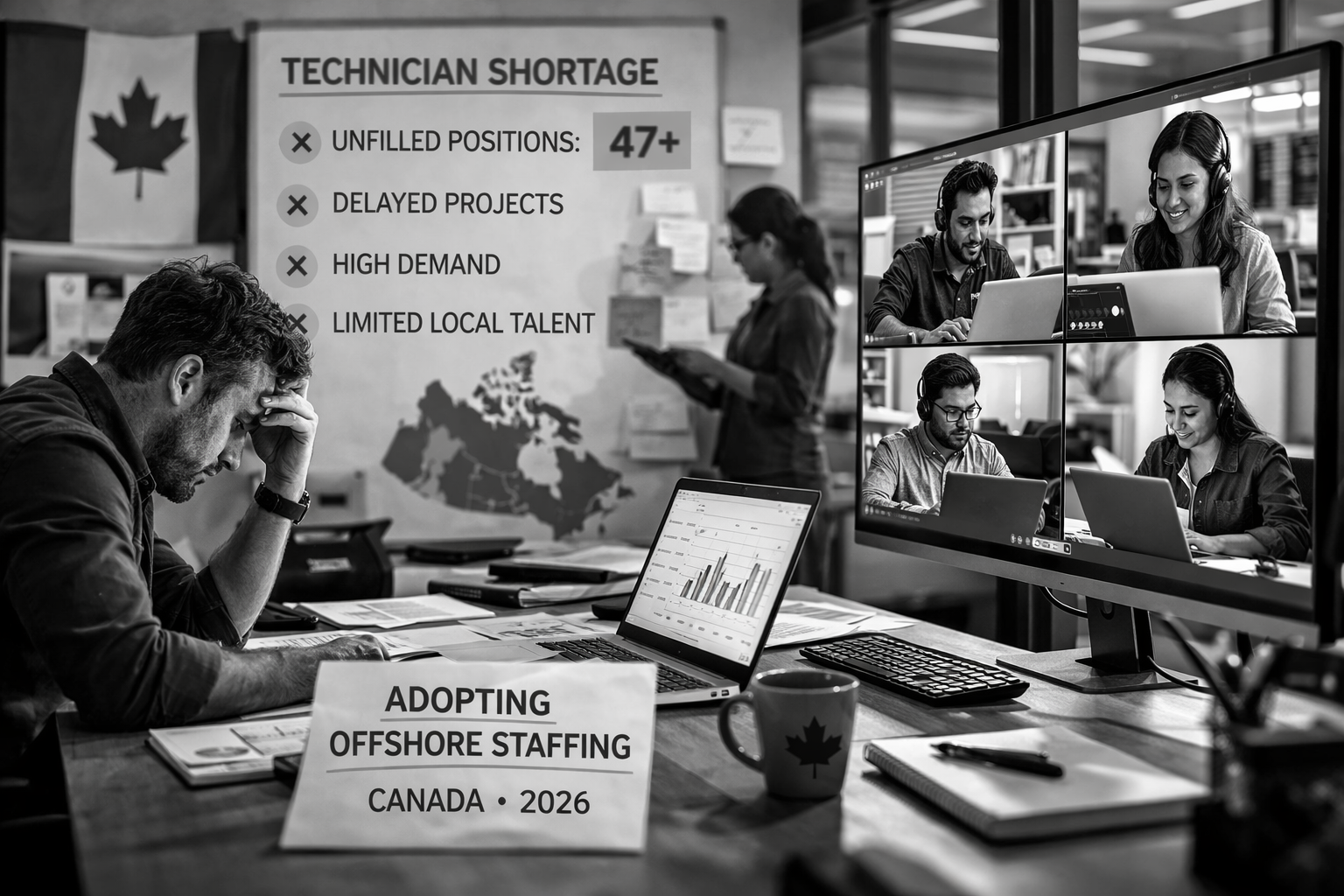
Canada's technology labour market has two realities running simultaneously, and they create a specific kind of misery for MSPs caught between them.
The first reality: demand for IT support roles is growing consistently. Small and mid-sized businesses across Toronto, Vancouver, Calgary, and Montreal are adding devices, cloud services, and compliance requirements faster than their internal capacity can absorb. MSPs serving those businesses are in a structurally good position — the market needs what they sell.
The second reality: the people needed to deliver that service are increasingly unavailable at prices that make sense for an MSP operating on 20–30% margins. As Acara Solutions' analysis of Canada's tech hiring market frames it, Canada faces an estimated 250,000 additional tech jobs needed — creating a competitive landscape that is forcing employers to completely rethink their approach to talent acquisition. The companies competing against MSPs for that shallow talent pool include enterprise tech firms offering salaries and equity that managed services businesses simply cannot match at the L1 level.
The result is a hiring ceiling that keeps MSPs from growing not because there aren't enough clients, but because there aren't enough technicians to service them. This post is about the specific model Canadian MSPs are using to break through that ceiling — and why the Philippines, specifically, is where most of them are finding the answer.
What the Canadian Hiring Market Actually Looks Like at the L1 Level in 2026
Industry-level data about the Canadian tech shortage tends to focus on senior roles: cloud architects, cybersecurity specialists, software engineers. Those shortages are real, but they're not where the daily operational pain is sharpest for MSPs. The pain is at the helpdesk level, and the numbers there tell a specific story.
According to the Robert Half Canada Demand for Skilled Talent Report, 48% of technology and IT hiring managers plan to increase hiring in 2026 — with only 5% of leaders saying they already have the necessary headcount and skills on their teams to accomplish their targets. That means 95% of Canadian IT leaders are going into 2026 with acknowledged staffing gaps. For MSPs operating at the frontline of client service delivery, that gap isn't abstract — it's the queue that backs up on a Tuesday afternoon when someone calls in sick.
The salary data compounds the problem. Robert Half's 2026 Canada Salary Guide puts the Tier 1 help desk range in Toronto at $52,411 to $67,534 CAD annually. Glassdoor's February 2026 data shows Vancouver averaging $49,978 CAD for the same role, with top earners reaching $68,420. Indeed puts the Toronto helpdesk technician average at $60,859 CAD. Across those three sources, the realistic hiring cost for a single L1 technician in a major Canadian city sits between $50,000 and $70,000 CAD in salary alone — before CPP contributions, EI premiums, benefits, equipment, and the management overhead of onboarding and retaining someone in a role with historically high turnover.
And the role still turns over. Entry-level helpdesk work in Canada carries approximately 40% annual turnover, driven by technicians using L1 roles as stepping stones to higher-paying specialist positions. The hiring cycle is effectively continuous for most MSPs — not a periodic exercise but an ongoing operational cost. The Indeed 2026 Canadian Jobs and Hiring Trends Report notes that more than half of technology managers in Canada plan to expand their use of contract talent — recognizing that the traditional permanent hire model has become economically unviable for many technical roles. Contract staffing offers more flexibility, but it solves the availability problem without solving the cost problem, and it introduces its own continuity challenges for client-facing support roles where relationship familiarity matters.
The Cost Comparison Canadian MSPs Need Before Making a Decision
The gap between local Canadian hiring costs and offshore Filipino staffing costs is wide enough that it warrants being laid out explicitly. The salary benchmarks below are drawn from Robert Half's 2026 Canada Salary Guide and Glassdoor's February 2026 data for Vancouver and Toronto. The additional employment cost components — CPP, EI, benefits — reflect standard statutory obligations under the Canada Labour Code and provincial employment standards.
| Cost Component | Local Canadian L1 Technician (CAD) | Filipino Remote L1 Technician (CAD equiv.) |
|---|---|---|
| Base Salary / Service Fee | $52,000–$70,000 | $17,000–$27,000 |
| CPP + EI Contributions | $4,500–$6,200 | $0 (not applicable) |
| Benefits (health, dental) | $4,000–$8,000 | $0 (managed by staffing partner) |
| Equipment and workspace | $2,500–$5,000 | $0 (remote, own setup) |
| Recruitment cost (one-off) | $4,000–$10,000 | $0 (handled by Konnect) |
| Total Annual Cost (est.) | $67,000–$99,000+ CAD | $17,000–$27,000 CAD |
The annual saving on a single technician runs between $50,000 and $72,000 CAD. For an MSP operating on a 25% margin, that saving is equivalent to adding $200,000–$288,000 in annual revenue — without acquiring a single new client. It is, in financial terms, one of the highest-leverage operational decisions available to a growing Canadian MSP.
How the Time Zone Works for Canadian MSPs
Unlike Australian MSPs, where Philippine time zones align naturally with business hours, the Canada-Philippines time arrangement requires more deliberate planning. The Philippines is UTC+8. Canadian time zones run from UTC-3.5 (Newfoundland) to UTC-8 (Pacific). That puts Manila between 11.5 and 16 hours ahead of Canadian local time depending on province and daylight saving.
| Canadian City | Time Zone | When Manila is 8am–5pm | Coverage Window (Canadian Time) | Best Use |
|---|---|---|---|---|
| Toronto / Ottawa | EST (UTC-5) | 7pm–4am Eastern | Evening + overnight | After-hours and overnight coverage |
| Winnipeg | CST (UTC-6) | 6pm–3am Central | Evening + overnight | After-hours and overnight coverage |
| Calgary / Edmonton | MST (UTC-7) | 5pm–2am Mountain | Late afternoon + overnight | End-of-day overflow + overnight |
| Vancouver | PST (UTC-8) | 4pm–1am Pacific | Late afternoon + overnight | End-of-day overflow + overnight |
The practical implication is that a Filipino technician on a standard Manila day shift covers Canadian evenings and overnights — exactly the window most Canadian MSP owners are currently absorbing personally or leaving uncovered. For West Coast MSPs in Vancouver and Calgary, there's a useful 1–3 hour overlap in late afternoon where the Filipino technician is finishing their day while local Canadian staff are still at work, enabling clean handoffs on open tickets. For MSPs that need daytime coverage during Canadian business hours, Filipino technicians can work a modified evening shift in Manila (roughly 4pm–1am Manila time). This requires a shift premium, but the cost differential with local hiring remains substantial even with that adjustment.
What the Shortage Looks Like From Inside a Canadian MSP
The way the hiring shortage manifests inside a growing Canadian MSP follows a pattern familiar to owners who've lived it.
You need someone for the ticket queue. You post the role. Candidates apply — some good, most not quite right for the specific combination of technical competency, communication quality, and client-facing composure that helpdesk work actually requires. You interview. You make an offer. The candidate accepts and then takes a counter-offer from a larger firm three days before their start date. You repost. The queue backs up.
When you do successfully hire, the clock starts on a retention challenge that the data frames clearly. Entry-level L1 roles in Canada see 40% annual turnover — meaning the average technician in that seat is gone within 18 months, often within 12. They're using the role to build their resume for the next job at a company that pays more for mid-level technical work. You've invested onboarding time, tool access, client relationship familiarity — and then you're recruiting again. The Robert Half 2026 report found that 69% of Canadian tech leaders say upskilling current employees is needed just to meet their targets for the year — a signal that the domestic talent pipeline isn't producing work-ready candidates fast enough even for internal development, let alone for external hiring into client-facing roles.
The structural reality, as the Indeed 2026 Canadian Jobs and Hiring Trends Report frames it, is that many of the themes that defined the Canadian labour market in 2025 have been in place since at least 2022 — and it's a safe bet that many will continue into 2026. This is not a temporary post-pandemic disruption resolving itself. It is a durable condition that requires a structural response, and the MSPs finding their footing fastest are the ones who stopped waiting for domestic hiring to get easier.
Why Filipino L1 Technicians Specifically Work for Canadian MSP Environments
The case for Filipino IT professionals in Canadian MSP contexts goes beyond cost. There are three specific attributes that make the fit particularly reliable.
English communication quality. The Philippines has been consistently ranked among the top countries globally for English proficiency in the EF English Proficiency Index. Filipino professionals working in North American-facing IT support roles are experienced with the communication norms Canadian clients expect — clear explanations, appropriate technical vocabulary without jargon overload, professional phone manner. The communication quality concern that most Canadian MSP owners raise before trying the model is consistently not the concern they report afterward.
Familiarity with North American tools and workflows. Filipino IT professionals entering the MSP support market are not learning North American tooling for the first time. ConnectWise, Autotask, HaloPSA, NinjaRMM, Datto, and Microsoft 365 administration are standard parts of the Filipino IT professional's working knowledge. The onboarding investment is in your specific client environments and your specific escalation preferences — not in the tools themselves.
Retention that actually holds. The 40% annual turnover that characterizes Canadian L1 helpdesk hiring is not replicated in well-managed offshore engagements. Filipino professionals in stable, well-managed remote roles with clear career paths and fair compensation show dramatically lower attrition than their Canadian counterparts in equivalent roles. The cultural factors that drive this — the value placed on long-term loyalty, the stigma attached to job-hopping, the genuine professional pride in doing technical work well — are covered in depth in the Konnect guide on managing across cultures with Filipino team members. The headline is that the revolving door dynamic that makes Canadian L1 hiring so exhausting largely disappears when the engagement is structured with genuine respect and clear career visibility.
What a Canadian MSP Engagement With Konnect Looks Like
The practical question for most Canadian MSP owners considering this for the first time is what the engagement actually looks like — not in theory, but in the first 60 days.
The starting point is your existing stack. Your remote technician gets provisioned into your PSA, your RMM, your communication channels, and your documentation. The first two weeks are access, familiarization with your client environments, and establishing escalation thresholds. What triggers an independent resolution versus what triggers a handoff to you, and how that handoff happens — those decisions, made clearly at the outset, determine how smoothly the model runs.
Weeks three and four introduce supervised live handling. Tickets come in through the normal queue. The technician works them. You review the outcomes the following morning and refine escalation boundaries where needed. By the end of week four, most technicians are largely independent on L1 scope.
By week six to eight, the pattern is established. Your overnight and end-of-day queue is being worked by someone competent, calm, and properly briefed on your clients — not by you, on your phone, after dinner. Escalations arrive as documented, structured handoffs rather than raw calls. The quality of your available hours improves even when the volume of work stays the same.
The Question Worth Asking Before the Next Hire
If you're a Canadian MSP owner who's currently in a hiring cycle — or who has stopped trying to hire because the process is exhausting and the results are unreliable — the question worth asking is whether the next local hire is actually the right solution, or whether it's just the familiar one.
The familiar path runs: post the role, interview, make an offer, onboard, watch them leave in 14 months, repeat. It's expensive, it's slow, and as Acara Solutions' Canada hiring market analysis puts it plainly — this is a candidate's market, not an employer's. The leverage is on the other side of the table, and it has been for years.
The alternative path starts with a 20-minute conversation about what your ticket volume looks like, what your current coverage gaps are, and whether one remote Filipino technician changes the picture in a way that makes the next 12 months materially better.
If you're a Canadian MSP owner sitting on open headcount or absorbing overnight tickets personally, let's have that conversation.
📅 Book a 20-minute call: https://meet.brevo.com/konnectph
✉️ Email us: hello@konnect.ph
We'll look at your situation specifically — your tools, your clients, your coverage gaps — and give you a straight answer about whether the model fits right now.
About the Author
Vilbert Fermin is the founder of Konnect, a remote staffing company connecting North American and Australian businesses with top Filipino talent. With deep expertise in IT support and remote team management, Vilbert helps MSPs access skilled technical professionals without the overhead of full-time domestic IT staff. His mission is to showcase Filipino excellence while helping businesses stay protected, productive, and competitive through strategic remote staffing.