How MSPs Use Offshore Staff to Win RFPs Against Larger Competitors
Small MSPs lose competitive bids to larger providers for reasons that are predictable, repeated, and mostly fixable. The technical solution is usually comparable. The relationship, when the MSP has cultivated it, is often stronger. But somewhere in the proposal or the evaluation process, two questions surface that smaller MSPs cannot currently answer as confidently as larger ones: can you deliver 24/7 support, and do you have enough capacity to absorb our growth? The answer to both questions, for a locally-only-staffed small MSP, tends to be qualified, hedged, or quietly inadequate — and the prospect reads that qualification as the risk it represents.
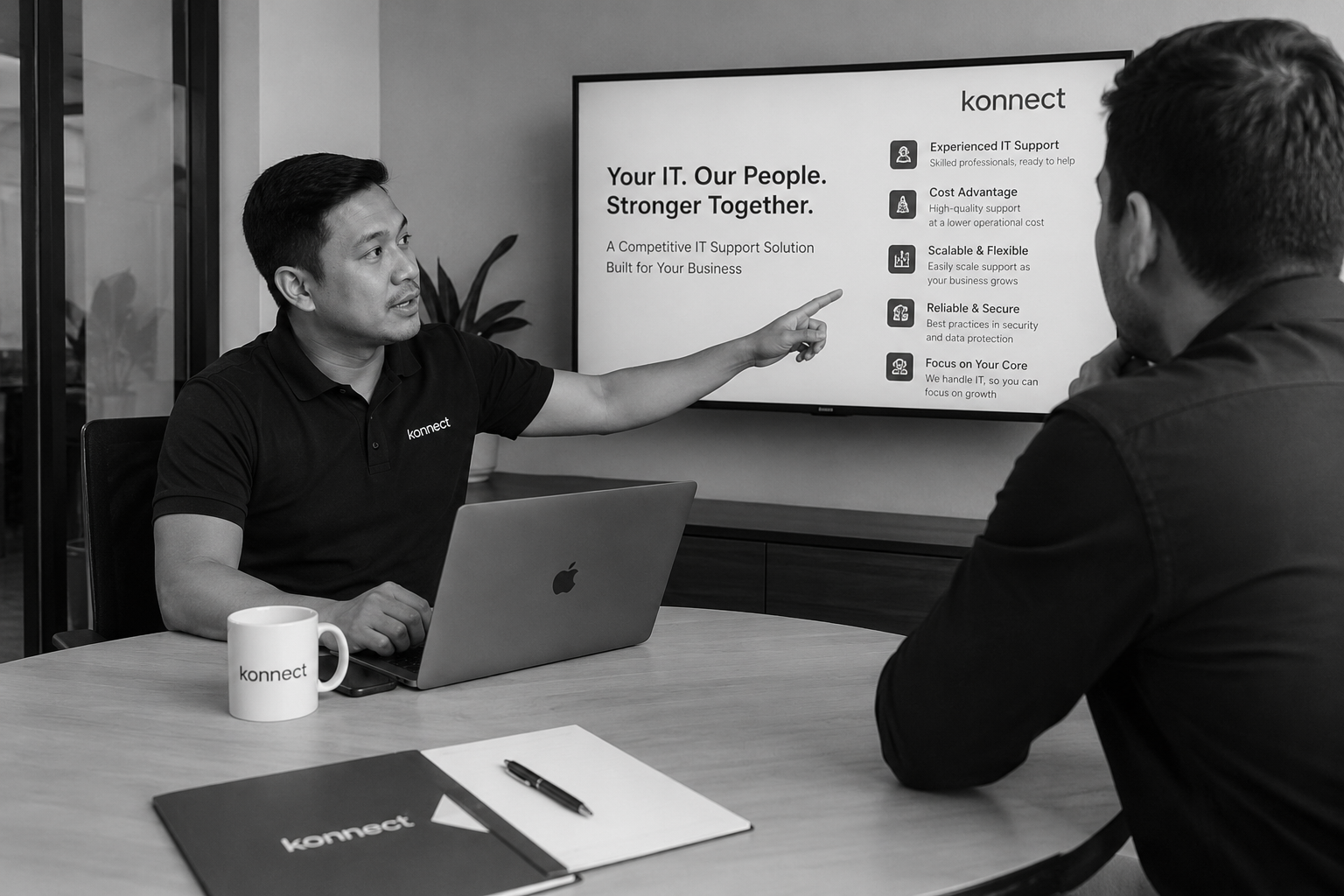
Offshore staffing changes both answers fundamentally. A small MSP with a Filipino overnight technician can answer the 24/7 question directly and credibly. A small MSP with an offshore staffing model that scales incrementally can answer the capacity question without committing to local headcount that the new contract would need to fund in advance. The larger competitor's advantage in a formal evaluation is not their technical solution — Bidara's April 2026 RFP Statistics research confirms that enterprise teams outperform SMBs primarily because of dedicated proposal teams and more mature content libraries, not because they offer inherently better solutions. The gap is in how the capability is presented and substantiated, not what the capability actually is.
The RFP Landscape Small MSPs Are Competing In
The average North American RFP win rate, according to Loopio's 2026 RFP Response Trends and Benchmarks Report, is 39% — meaning the average team loses six out of ten competitive bids it pursues. Top-performing teams achieve win rates of 60% or higher by being highly selective about which opportunities they pursue and by consistently deploying proposals that anchor claims in evidence rather than aspiration. The gap between a 39% win rate and a 60% win rate is not primarily a product quality gap. It is a proposal quality and positioning gap — specifically, the ability to demonstrate capability credibly rather than assert it confidently.
For small MSPs, the RFP challenge has two layers. The first is the written proposal itself — the document that gets evaluated before any relationship factor applies. The second is the live evaluation, where a prospect asks the capacity and coverage questions that the written proposal raised but did not fully answer. Offshore staffing is the structural change that allows a small MSP to address both layers with genuine confidence rather than hopeful framing.
The Two Questions That Lose Small MSP Bids
Question one: Can you deliver 24/7 support? This question appears in formal RFPs for businesses with operational requirements beyond business hours — manufacturing, healthcare, professional services firms where the principal works evenings, multi-location businesses with staff across time zones. The question has become increasingly standard because client expectations have shifted: 24/7 availability is no longer a premium feature but a baseline expectation for managed IT in 2026, as Worksent's December 2025 analysis of MSP outsourcing trends documents directly.
A small MSP without offshore coverage has one honest answer: we have on-call arrangements that ensure response, but the overnight call goes to a team member's personal phone. That answer is truthful and reasonable, but it does not compete well against a larger provider who can credibly say their helpdesk is staffed overnight. The prospect evaluating risk does not hear "we have a good on-call process." They hear "the overnight coverage is a person who may or may not be fully awake."
A small MSP with a Filipino technician covering the overnight window on a Manila day shift answers the same question completely differently: yes, our helpdesk is staffed from 7pm to 4am Eastern by a dedicated technician who is at their desk during their normal working day. That answer is not a hedge. It is a direct, specific, verifiable claim that competes equally with what any enterprise provider can say.
Question two: Do you have enough capacity to absorb our growth? This question is most common from clients in growth phases — businesses that are adding headcount, opening new locations, or expanding their IT footprint — who want to know that the MSP they select will not become a bottleneck as their requirements scale. A locally-only-staffed small MSP with a team at or near utilisation ceiling has an honest constraint: adding a client at the scale of this prospect would require adding local headcount, which takes 45–90 days to hire and costs $77,000–$130,000 annually before a single new ticket is handled.
A small MSP with an offshore staffing model answers the capacity question differently. The incremental cost of adding another offshore technician to absorb new client volume is lower, faster, and less financially risky than a local hire. The MSP can honestly say: our delivery model is designed to scale incrementally as your requirements grow, and we have a staffing structure that adds capacity in two to four weeks rather than three months. That is a credible capacity story. The local-only-staffed answer is not.
How to Build the Offshore Advantage Into Your Proposal
AutoRFP.ai's Proposal Win Rate Report 2026 identifies a specific structural difference between high-win and low-win proposals: high-win teams use defined win themes 71% of the time versus 42% for low-win teams, and they anchor those themes to evidence rather than claims. For a small MSP competing on offshore-enabled capabilities, the win themes are specific and provable — but only if the proposal is structured to make them visible rather than burying them in a list of service features.
The offshore capability advantage translates into three concrete proposal elements that change the evaluation.
The coverage section: specific, staffed, and verifiable. Rather than a coverage table that lists "24/7 support available" as a feature, the winning proposal describes the coverage architecture: business-hours support delivered by local senior engineers in your time zone; overnight and weekend coverage delivered by a dedicated remote engineer in the Philippines, working their normal business hours, with no on-call arrangement or sleep-disrupted response. The specificity signals that this is a designed system, not a contingency. Prospects reading this against a vague "24/7 helpdesk availability" claim from a larger provider are receiving more operational confidence from the smaller MSP's answer.
The capacity and scalability section: structured, not aspirational. Most small MSP proposals address capacity with a general statement about the team's experience and commitment. The offshore-enabled proposal addresses it with a structural description: we scale delivery capacity by adding to our remote team, which we can do in two to four weeks without local hiring timelines or fixed overhead commitments. That description is specific enough to be believable, structured enough to be reassuring, and true enough to stand up to follow-up questions.
The pricing section: competitive without margin sacrifice. The cost structure improvement from offshore delivery allows a small MSP to price 10–15% below a local-only competitor at equivalent or better margin. In a formal RFP evaluation where multiple providers are being compared on a per-user price basis, that pricing advantage is visible and material. The prospect evaluating value receives a provider who has credible 24/7 coverage, credible scale capacity, and a more competitive per-user rate than the larger provider — and is doing so without the small MSP sacrificing margin to win the bid.
| RFP Evaluation Criterion | Small MSP Without Offshore (typical answer) | Small MSP With Offshore (competitive answer) | Prospect's Evaluation |
|---|---|---|---|
| 24/7 support coverage | "On-call arrangements ensure response outside business hours" | "Overnight coverage staffed by dedicated engineer working Manila business hours — 7pm–4am Eastern" | Specific, credible answer competes directly with enterprise providers |
| Capacity to absorb growth | "Our experienced team is fully committed to client success" | "We scale delivery capacity incrementally in 2–4 weeks through our remote staffing model, not 45–90 day local hiring cycles" | Structural answer reduces perceived growth risk |
| Per-user pricing | $175–$225/user/month at 40% gross margin with local delivery | $150–$190/user/month at 55% gross margin with offshore delivery | 10–15% pricing advantage at equivalent or better margin |
| Response time commitment | 15-minute response during business hours; best-effort overnight | 15-minute response commitment across all covered hours, including overnight | SLA parity with enterprise providers in the evaluation |
The Go/No-Go Decision That Improves Win Rates More Than Any Proposal Tactic
Loopio's data shows that top-performing proposal teams achieve 60%+ win rates partly through process maturity and partly through disciplined qualification — being highly selective about which opportunities they pursue. For small MSPs, this qualification discipline is particularly important because every proposal that requires significant investment in a bid the MSP was unlikely to win anyway is time not spent on relationship-led pipeline where win rates are materially higher.
The offshore capability changes the qualification calculus in a specific way: the 24/7 and capacity questions that previously disqualified many formal RFP opportunities for locally-staffed small MSPs are no longer automatic disqualifiers. The MSP with offshore coverage can pursue a wider range of formal RFPs credibly — not every opportunity, but a larger set than before. The right filter is whether the prospect is within the client profile where the MSP's relationship, specialisation, and service quality advantages apply. Where those advantages apply and offshore enables the coverage and capacity story, the MSP is genuinely competitive.
The Konnect guide on how small MSPs compete with enterprise providers using offshore leverage covers the broader competitive positioning picture. The RFP-specific application is the most concrete expression of that positioning — it is where the offshore capability difference shows up as a signed contract rather than a competitive advantage that never gets tested.
If you are an MSP owner who has lost formal bids to larger providers and wants to understand how offshore staffing changes the proposal story you can credibly tell:
📅 Book a 20-minute call: https://meet.brevo.com/konnectph
✉️ Email us: hello@konnect.ph
We work with MSP owners on both the staffing model and the commercial positioning that makes the offshore advantage visible where it matters most — in a competitive evaluation.
About the Author
Vilbert Fermin is the founder of Konnect, a remote staffing company connecting North American and Australian businesses with top Filipino talent. With deep expertise in IT support and remote team management, Vilbert helps MSPs access skilled technical professionals without the overhead of full-time domestic IT staff. His mission is to showcase Filipino excellence while helping businesses stay protected, productive, and competitive through strategic remote staffing.
Related Resources