How to Stop the MSP Margin Squeeze in 2026: The Offshore Tier 1 Helpdesk Strategy
It is 2:15 AM on a Saturday. Your mobile device begins buzzing relentlessly because a key client’s server cluster is throwing memory errors and locking out their entire overnight logistics team. Your only available local technician called in sick on Friday afternoon, meaning you, the MSP owner, are pulling on a hoodie and logging into the remote monitoring and management dashboard instead of sleeping. This scenario is playing out across the United States, Canada, and Australia every single weekend. You started your managed service provider business to build a scalable, profitable enterprise, but the current labor market has turned many owners into highly paid, perpetually exhausted emergency dispatchers.
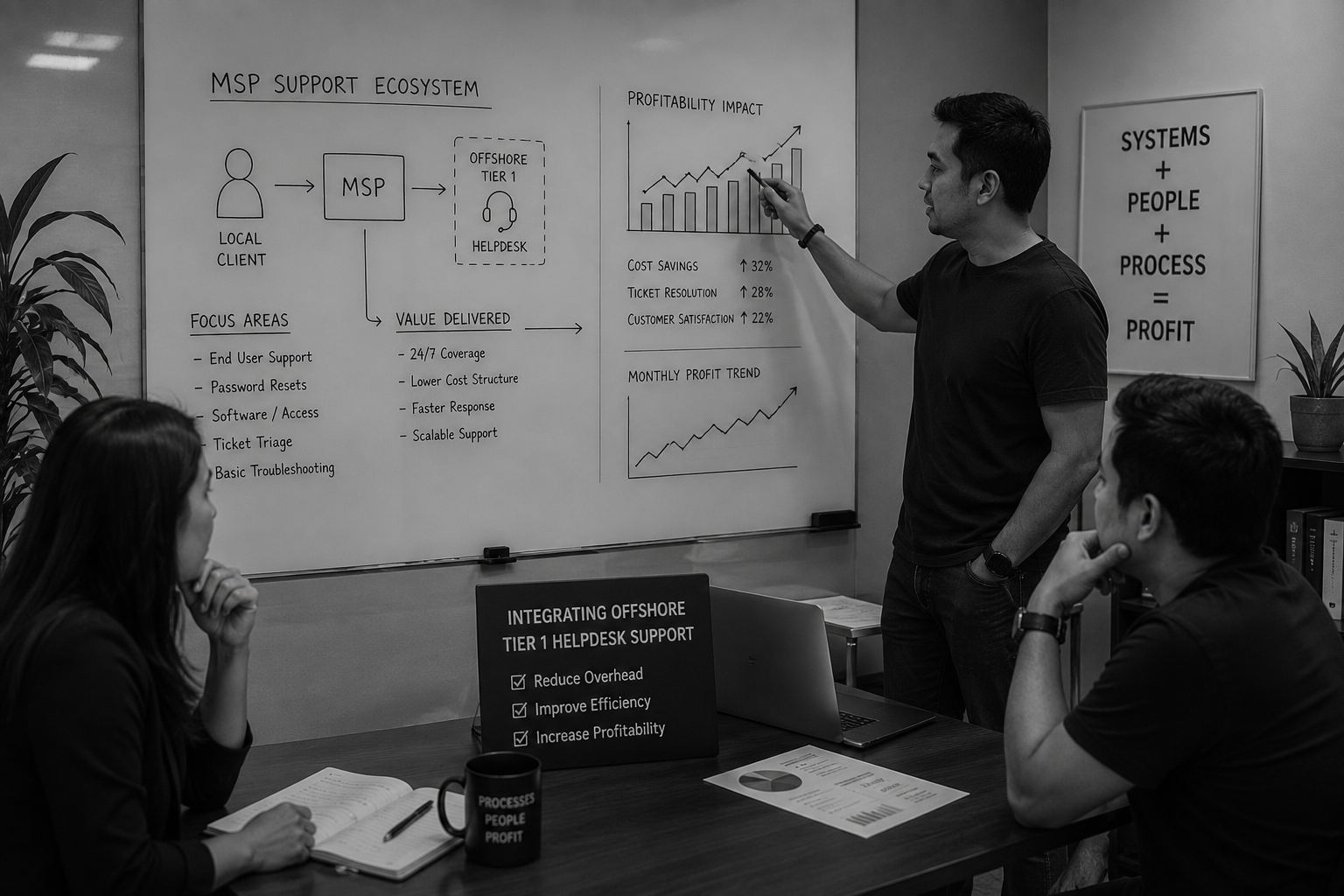
The brutal reality of operating an MSP in 2026 is that the traditional hiring model is mathematically breaking down. Clients expect faster resolution times, broader coverage windows, and heightened security protocols, yet they fiercely resist any adjustments to their monthly recurring revenue contracts. Simultaneously, the cost of acquiring and retaining domestic technical talent has reached unprecedented heights. According to the CompTIA State of the Tech Workforce report, hundreds of thousands of core IT support roles remain unfilled domestically, driving up base salaries for even entry-level technicians. When you are forced to pay a premium for junior talent that inevitably jumps ship for enterprise corporate IT roles twelve months later, your profit margins do not just shrink, they practically evaporate.
The Economics of the Modern Technician Shortage
To understand how severe the margin squeeze has become, you must look at the widening gap between service delivery costs and client pricing tolerance. Domestic L1 and L2 technicians now command compensation packages that heavily dilute the profitability of standard all-you-can-eat support agreements. When a local technician is spending four hours resetting passwords, managing printer queues, and triaging basic active directory lockouts, you are burning expensive domestic labor on low-margin tasks. The math simply does not support scaling your business if your most expensive assets are tied up in routine maintenance rather than complex project work or strategic client consultations.
This financial pressure is pushing many managed service providers toward a breaking point. Industry analysis from CRN Managed Services news indicates that mid-sized MSPs are increasingly struggling to maintain the standard twenty percent net profit margin historically associated with healthy operations. When you factor in the fully burdened cost of a domestic employee—including healthcare, retirement contributions, payroll taxes, physical office space, and continuous training—the actual expenditure is often thirty to forty percent higher than their base salary. Attempting to solve this by simply working your existing small team harder inevitably leads to massive staff turnover, which restarts the costly recruitment cycle and further degrades client service quality. For many leaders, discovering how small MSPs are using remote L1 support to stop being on call 24/7 is the first step toward reclaiming both their margins and their personal lives.
Decoding the True Cost and Value of an Offshore Helpdesk
Faced with these insurmountable domestic labor constraints, forward-thinking MSPs have abandoned the local-only hiring model in favor of establishing dedicated offshore Tier 1 helpdesk teams. The Philippines has emerged as the premier global destination for this specific operational pivot. Unlike other offshore hubs that focus heavily on software development or back-office data entry, the Philippines has systematically developed a massive workforce trained specifically in western-style customer service, technical troubleshooting, and managed IT environments. Their cultural alignment with Western business norms and near-native English proficiency ensures that your clients experience seamless, empathetic support interactions that reflect perfectly on your brand.
The strategic advantage extends far beyond simple wage arbitrage. Because the cost of entry is significantly lower, you can afford to build overlapping shifts, effectively creating a follow-the-sun support model. For Australian MSPs, the time zone overlap with the Philippines is virtually identical, meaning your remote team is working their standard day shift precisely when your clients need them most. For North American providers, Filipino professionals are deeply accustomed to working the night shift to align with US and Canadian business hours, allowing you to offer true 24/7 network operations center coverage without forcing your local senior engineers to sleep with their phones on loud. Research from Gartner's Global IT Services portal consistently highlights the Philippines as an indispensable component of resilient IT service delivery frameworks worldwide.
Acknowledging the Boundaries of the Remote Model
While building an offshore technical team is a transformative strategy for protecting margins, maintaining credibility with your clients requires you to be honest about where the model has its limitations. An offshore technician, regardless of their immense skill and dedication, cannot rack a new server, run cabling through a ceiling grid, or physically troubleshoot a failing hard drive on a client's premises. The offshore strategy is not about completely eliminating your domestic workforce; it is about providing them with incredible leverage. When you route the vast majority of your routine ticket volume to a highly capable offshore team, your expensive local engineers are freed up to handle the critical on-site deployments, deep architectural design, and high-level client relationship management that actually justify premium billing.
Furthermore, integrating a remote workforce requires a rigorous commitment to documentation. If your MSP currently operates on tribal knowledge stored only in the heads of your senior founders, an offshore team will initially struggle to deliver value. Success demands well-defined standard operating procedures, robust knowledge bases, and clear escalation protocols. You must invest time in training your Filipino staff on your specific tool stack, exactly as you would with a local hire sitting in the desk next to you. Deciding whether you should solely focus on basic triage or if you can you outsource Tier 1 and Tier 2 support ultimately depends on the maturity of your internal processes and your willingness to treat remote staff as integrated members of your core business rather than disposable contractors.
Transitioning Your Client Base Without Service Disruption
The final hurdle for most MSP owners is the fear of client pushback. Many worry that clients will perceive an offshore helpdesk as a reduction in service quality. The reality is that end-users do not care where their technician is sitting; they care about how quickly their password is reset so they can get back to their jobs. When implemented correctly, offshore staffing should actually decrease your average time to resolution and eliminate the voicemail black hole that clients experience when your local team is overwhelmed. You can choose a transparent approach, openly introducing your expanded global team as a massive upgrade in availability, or a white-labeled approach where the offshore staff operate entirely behind your branding, email signatures, and internal telephony systems.
To execute this transition flawlessly, start by routing only specific categories of tickets to your new remote team. Have them handle proactive monitoring alerts, backup verifications, software patching, and basic user account creation. As they master these foundational tasks and adapt to your internal culture, you can gradually expose them to direct client communication via email and chat, followed eventually by inbound phone support. This phased approach allows you to perform quality assurance on every interaction, ensuring that the legendary Filipino hospitality and technical proficiency shine through. By taking back control of your largest expense category, you can stop the margin squeeze, scale your client base aggressively, and finally turn your pager off on the weekends.
📅 Book a 20-minute call: https://meet.brevo.com/konnectph
✉️ Email us: hello@konnect.ph
Stop losing sleep and shrinking your margins over routine helpdesk tickets. Reach out today to discover how a dedicated Filipino Tier 1 technician can restore your profitability and bring sanity back to your MSP operations.
About the Author
Vilbert Fermin is the founder of Konnect, a remote staffing company connecting North American and Australian businesses with top Filipino talent. With deep expertise in IT support and remote team management, Vilbert helps MSPs access skilled technical professionals without the overhead of full-time domestic IT staff. His mission is to showcase Filipino excellence while helping businesses stay protected, productive, and competitive through strategic remote staffing.