Offshore Continuity Planning for MSPs: Typhoons, Power Cuts, and Internet Outages in the Philippines
The Philippines' national weather service, PAGASA, reports that an average of 20 tropical cyclones enter the Philippine Area of Responsibility each year, with about 8 or 9 of them crossing the country, and that nearly 70 percent of typhoons develop between July and October. If you run an MSP with Filipino staff, some of your technicians will lose power, internet, or the ability to travel because of weather at some point. That is a planning fact, and it is manageable, but it needs to be planned before the storm rather than during it.
This post explains what actually fails when weather or infrastructure problems hit, what Philippine labor guidance says about work suspensions, and how MSPs structure coverage so client tickets keep moving. It also covers what to ask any staffing provider about their continuity arrangements, because the answers vary a lot.
Three Kinds of Disruption, and Why They Need Different Plans
It helps to separate the problems, because they have different scopes and different fixes. The first is an individual outage: one technician's power or home internet goes down while everyone else is fine. This happens in any country and is the most common event by far. The second is a regional event, usually a typhoon or severe monsoon rain, that affects everyone in a particular area at once, so several staff in the same city or province can be offline together. The third is a prolonged regional outage, where power or connectivity stays down for a day or more after a major storm. Each calls for a different response, and a plan that only covers the first leaves you exposed to the other two.
The main planning lesson is correlation. If all your offshore technicians live in the same city and use the same internet provider, one event can take all of them down together, which is the situation a continuity plan exists to prevent. Where your staff live and how they connect matters as much as how many of them you have.
Typhoon Season: What You Can Know in Advance and What the Rules Say
Typhoons are the most predictable of the three, because storms are tracked and forecast days ahead, and PAGASA publishes tropical cyclone information that the public and employers use to prepare. That gives you a window to move work forward, confirm who is available, and warn your own team and clients before conditions worsen. The peak period runs from July through October according to PAGASA, though storms can occur outside it.
Philippine labor guidance shapes how your staff are treated during these events. In Labor Advisory No. 14, series of 2026, issued on 19 August 2026, the Department of Labor and Employment reminded private employers that they may suspend work during severe weather. Employees who report for at least six hours during a suspension are entitled to their full regular pay, and those who work fewer than six hours may receive proportional pay. Workers who do not report are generally not entitled to regular pay unless a more favorable company policy, collective agreement, or accrued leave credit applies, and employees who stay away because of an imminent threat from the weather should not face administrative sanctions.
Three practical points follow. First, you cannot treat a technician who is unreachable during a storm as a disciplinary matter, and a plan that depends on penalising absence will fail. Second, whether to suspend work, and how pay works during that period, is a question for the employer in the Philippines, so you need to know who that is and what their policy says. Third, because pay and attendance rules vary by arrangement, your continuity plan should assume that some staff will be unavailable on storm days and arrange cover in advance rather than relying on goodwill. Konnect's calendar of Philippine holidays for 2026 and 2027 covers the predictable days off, and a continuity plan handles the unpredictable ones.
Internet: Speed Is Not the Problem, Reliability and Location Are
MSP work is light on bandwidth. A technician working in your PSA, RMM, and chat tools does not need a very fast connection, so headline speed figures are less important than they sound. For context, BusinessWorld reported that in Ookla's August 2026 index the Philippines ranked 62nd of 149 markets for fixed broadband, with a median download speed of 114.34 Mbps against a global median of 129.68 Mbps, and 71st of 102 for mobile, at 66.33 Mbps against 109.05 Mbps globally. Those medians are below the global figures but well above what ticket work requires.
Where the figures matter is regional variation. In a separate BusinessWorld feature on Ookla's second quarter 2024 data, CALABARZON recorded a median fixed download speed of 99.55 Mbps while Eastern Visayas recorded 38.43 Mbps, which the report attributed to limited broadband infrastructure. A technician in a well-served area near Metro Manila and one in a less-served province will not have the same connection quality or the same recovery time after an outage. That is a reason to be deliberate about where your technicians are based, particularly for roles that carry overnight or sole-coverage responsibilities.
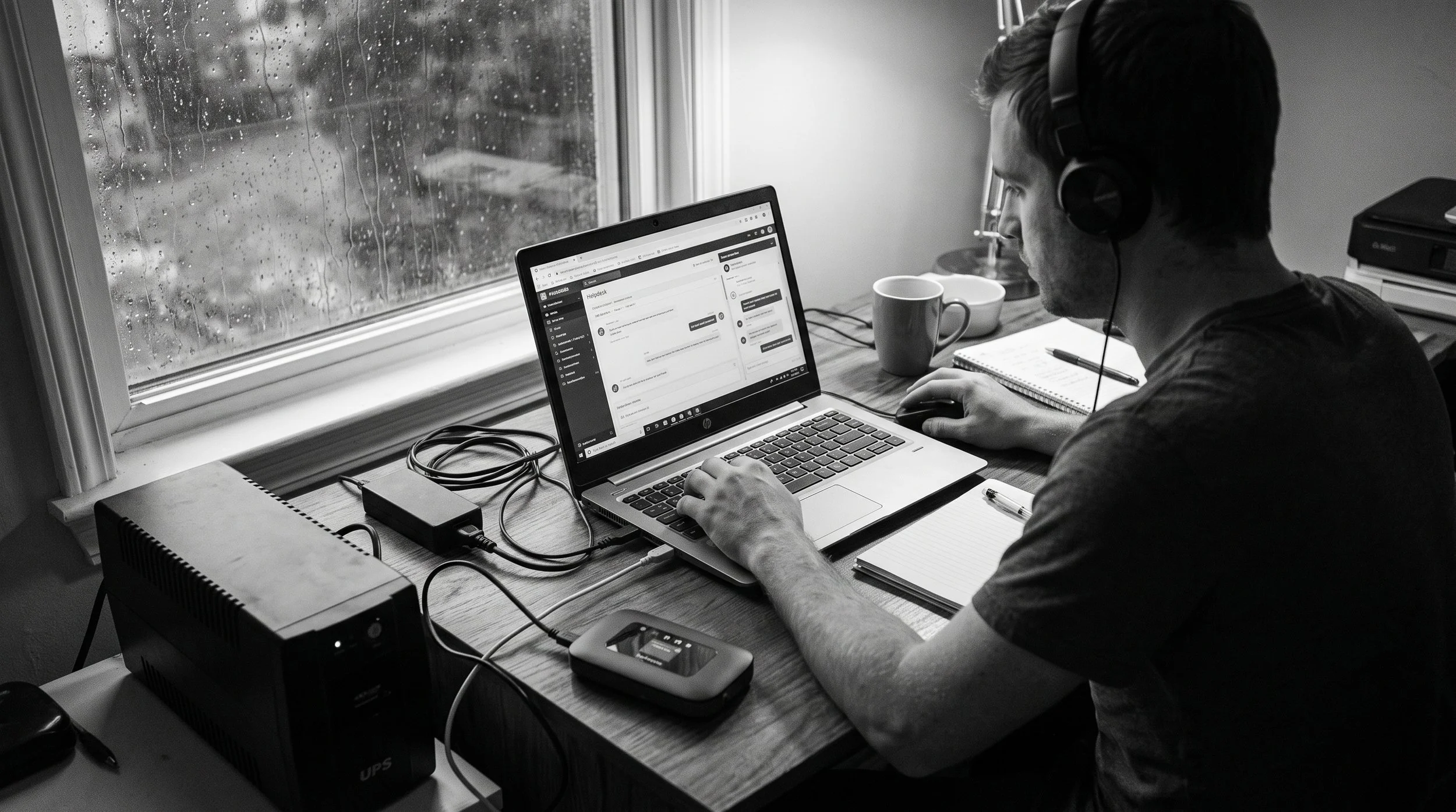
The standard protection is a second, independent connection. A technician with home fiber should also have a mobile data connection on a different carrier, ideally a hotspot or tethering plan that can carry the workday if the fixed line fails. Two connections from the same provider do not count, because a failure upstream takes both down. The cost is small compared with a missed shift, and it should be agreed and funded before the first day of work.
Power: Plan for Outages, Especially After Storms
Power interruptions are the least predictable of the three and the hardest to fix from your side. A technician who loses power also loses the modem and router, so a mobile backup helps only if the laptop is still charged. The usual measures are a laptop rather than a desktop, since the battery carries the workday, a small UPS or battery backup for the modem and router, and a power bank for the phone hotspot. For roles that carry sole coverage, a fallback location, such as a co-working space or office with backup power, is worth arranging in advance. None of this is exotic, but it only works if it is set up before the storm and tested.
What Each Event Costs You, and What to Do
The table below sets out the three kinds of disruption, what each affects, and the plan that fits.
| Event | What it affects | What to have in place |
|---|---|---|
| Individual outage (power or home internet) | One technician for hours, possibly a shift | Backup mobile connection, laptop with battery, a named teammate who can take the queue, and a rule that the technician reports an outage immediately |
| Regional storm or monsoon rain | Several staff in the same area at once, with travel and utilities disrupted | Staff spread across locations and providers, pre-storm check-ins, queue triage plan, and onshore on-call ready to take escalations |
| Prolonged regional outage after a major storm | Staff in the affected area unavailable for a day or more | Coverage from staff in an unaffected location or from your onshore team, client notification, and agreed priorities for what gets handled first |
How to Structure Coverage So One Event Does Not Take Everything Down
Three design choices do most of the work. First, avoid concentrating risk geographically. If your overnight coverage depends on two Filipino technicians, they should not live in the same neighborhood and share an internet provider, because the same event would take out both. Second, build overlap rather than a single point of failure, so that for any shift there is a named second person who can take over, even if that person is in a different shift or time zone. Third, keep an onshore escalation path that works when the offshore side is dark. Your senior engineer or on-call person should be able to pick up the queue, which means the offshore technician's work has to be documented well enough for someone else to continue it. Konnect's guide to managing shift handoffs between local and offshore teams covers the handoff practices that make this work.
For a forecast storm, a simple sequence helps. Around three days out, confirm which staff are in the likely path and who is available. The day before, move any scheduled maintenance or non-urgent project work off the affected window, update the handoff notes, and make sure the on-call person knows what may land on them. During the storm, have the offshore team check in at an agreed cadence, even a brief message, so you know who is reachable. Afterward, review which tickets slipped and why, and adjust the plan. The review is as important as the preparation, because the second storm tests whatever you changed after the first.
Telling Clients, and Setting SLAs You Can Keep
Your client agreements should reflect that overnight coverage by offshore staff carries some risk of interruption, and that you have a plan for it. Promising uninterrupted offshore coverage with no backup is a commitment you cannot guarantee, whether the staff are in Manila or Dallas, since local teams also face hurricanes, ice storms, and bushfires. The more credible position is that coverage is built with redundancy and an onshore fallback, with response times that account for it. Whether to tell clients that part of your coverage is offshore is a separate decision that depends on your positioning and contracts. The point here is that your SLA should be one you can meet when a technician is offline, since a continuity plan that exists only on paper does not help when a client ticket is waiting.
Questions to Ask a Staffing Provider About Continuity
These apply to any provider, including us. First, do you have a written continuity plan for typhoon season, and has it been used or tested. Second, where are your staff located, and how many are concentrated in the same area. Third, what backup internet and power arrangements are provided or required, and who pays for them. Fourth, what is your policy on work suspensions and pay during severe weather, and how does it align with DOLE guidance. Fifth, how quickly can you reassign work or provide cover if a technician is unavailable. Sixth, how do you communicate with staff during an event, and how will you tell me who is reachable.
Konnect places dedicated Filipino IT professionals with MSPs, which means each person is part of your team and your queue rather than a shared pool. That is a strength for service quality, and it is also why continuity planning needs to be done with you rather than handled in the background. A dedicated technician who is offline leaves a visible gap in your coverage, so the plan has to say who covers it before the gap appears.
Where This Does Not Fit
There are limits to what planning can do. If your business depends on a single offshore technician for round-the-clock coverage of a critical client, no amount of backup internet makes that arrangement sound, and you need a second person or an onshore fallback. If your client contracts prohibit certain staff from accessing their systems from an alternate location, your backup arrangements need to fit within those terms, so check them first. And if you have no onshore escalation path at all, an offshore outage becomes your outage. Continuity planning reduces the impact of these events, but it does not remove them, and an honest conversation with your clients about that is better than a promise you cannot keep.
A Drill You Can Run Before the Next Storm
You do not need to wait for a typhoon to test your plan. Pick a quiet day and ask one offshore technician to work for two hours using only the backup connection, with the main line switched off. Check whether the VPN, PSA, and RMM sessions hold, whether response times change, and whether the technician can reach everything they need. Then ask the same technician to report a simulated outage and have the named backup person take over the queue, noting how long the handoff takes and what information was missing. Finally, have your on-call person pick up a handed-over ticket cold, to see whether your documentation is good enough for someone else to continue the work. Whatever breaks in the drill is cheaper to fix now than during a storm.
📅 Book a 20-minute call: https://meet.brevo.com/konnectph
✉️ Email us: hello@konnect.ph
If you rely on Filipino staff for after-hours or overnight coverage, bring your current coverage schedule and your clients' SLA terms to the call, and we will walk through where one outage could leave a gap and how to build redundancy into it.
About the Author
Vilbert Fermin is the founder of Konnect, a remote staffing company connecting North American and Australian businesses with top Filipino talent. With deep expertise in IT support and remote team management, Vilbert helps MSPs access skilled technical professionals without the overhead of full-time domestic IT staff. His mission is to showcase Filipino excellence while helping businesses stay protected, productive, and competitive through strategic remote staffing.