Philippine Holidays and Work Calendar 2026–2027: A Complete Guide for MSPs with Offshore Teams
One of the first things that surprises North American and Australian MSPs when they bring on Filipino IT professionals is the holiday calendar. The Philippines has one of the most holiday-rich schedules in Asia—18 or more nationally recognized observances annually, ranging from religiously significant events that genuinely pause the country to administrative commemorations that most urban professionals work through without much fanfare.
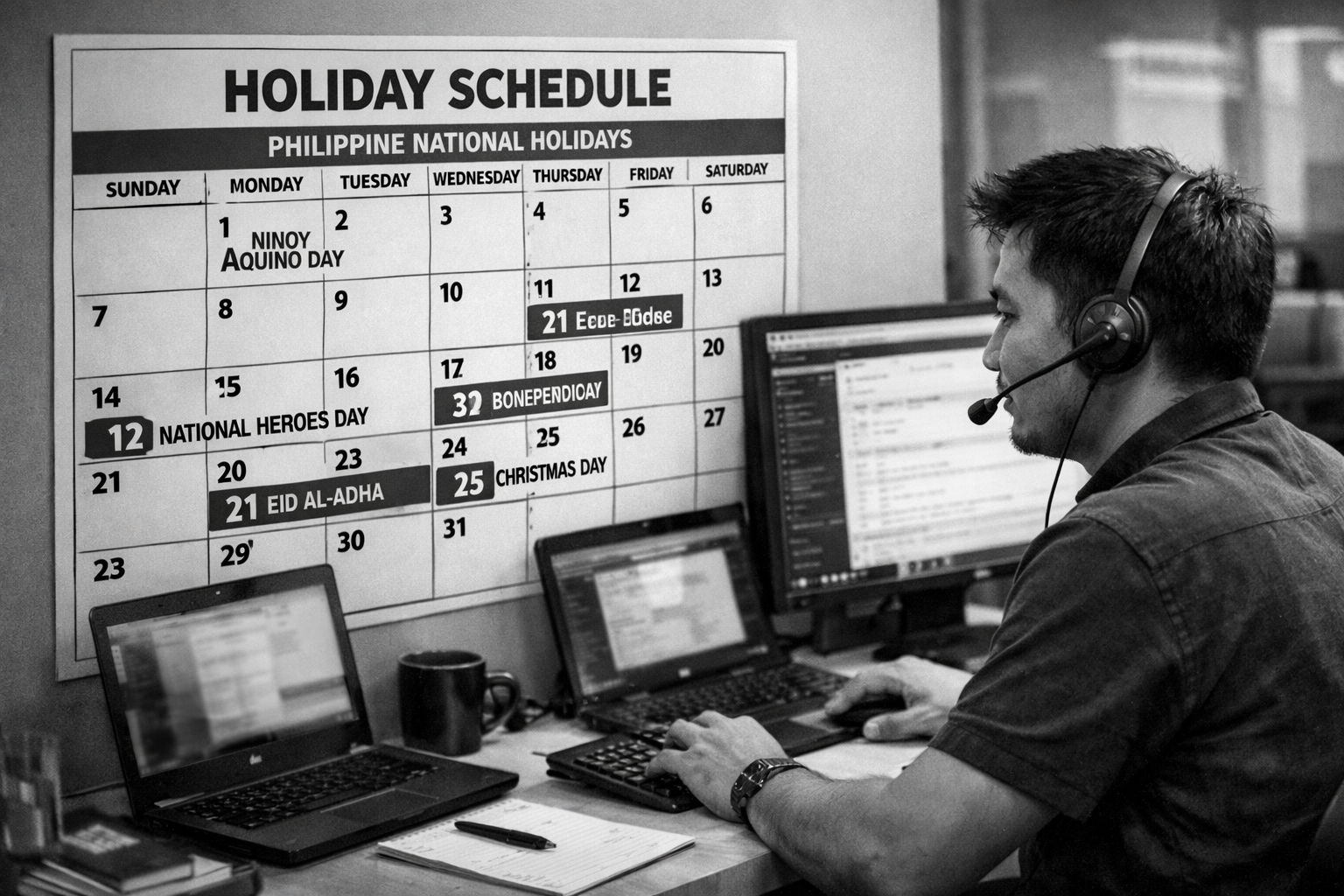
Understanding this calendar isn't just operational housekeeping. It's the difference between a coverage gap that blindsides your clients and a well-planned rotation that maintains SLAs without asking anyone to violate the cultural events that matter to them. Managed correctly, the Philippine holiday calendar becomes something you plan around with confidence rather than discover mid-incident.
This guide gives you the complete 2026 and 2027 Philippine holiday calendar with MSP-relevant context for each window, the legal pay framework your staffing arrangements need to account for, and the planning approach that experienced offshore teams use to stay ahead of the schedule all year.
Why Philippine Holidays Carry More Weight Than North American Ones
In North American corporate culture, public holidays are relatively few and the general expectation is that support operations maintain some level of coverage on most of them. In the Philippines, holidays—particularly religious ones—carry cultural weight that is genuinely different in character and intensity.
The Philippines is one of the most predominantly Catholic nations in the world, with approximately 86% of the population identifying as Catholic. This shapes the holiday calendar profoundly. Holy Week—the four days from Maundy Thursday through Black Saturday before Easter—is not simply a long weekend. It is one of the most significant cultural and religious events of the year. Many Filipino professionals travel to their home provinces during Holy Week. Manila empties noticeably. Scheduling critical work during this window without advance planning and explicit team agreement creates unnecessary friction and erodes trust.
Similarly, the Christmas season in the Philippines begins as early as September and peaks across a cluster of December holidays that effectively create an extended celebration window. All Saints' Day and All Souls' Day in November prompt significant family travel, with Filipinos returning home to visit graves. The cultural significance of these events runs deep across generations—it isn't performative.
Understanding this context matters for how you manage your team day to day. As covered in the Konnect guide on cultural intelligence for working with Philippine remote staff, managers who build lasting offshore relationships are those who treat cultural observances with genuine respect rather than as scheduling obstacles. The holiday calendar is one of the most visible places that respect either shows up or doesn't.
The Two Types of Philippine Holidays: Why the Legal Difference Matters
The Philippines Labor Code establishes two distinct holiday classifications, each carrying different pay obligations. Understanding the difference matters for compliance and for structuring coverage arrangements fairly.
Regular Holidays are nationally legislated fixed observances. Filipino employees who don't work on a Regular Holiday must still receive their full regular daily wage. Employees who do work are entitled to at least double their daily rate—200% pay. These are the holidays around which you need to build explicit coverage arrangements in advance, because both the pay premium and the cultural expectation of rest are significant.
Special Non-Working Days carry lighter obligations under a "no work, no pay" principle—employees who don't work receive no additional pay but are not penalized for taking the day. Employees who do work receive a 30% premium on top of their daily rate (130%). These days are generally more workable for voluntary coverage rotations.
Asking a Filipino team member to cover a Regular Holiday is a materially different conversation—with different cost and relationship implications—than asking them to cover a Special Non-Working Day. Knowing which is which before the calendar event arrives puts you in a position to plan rather than react.
The 2026 Philippine Holiday Calendar
The 2026 schedule below is drawn from President Ferdinand Marcos Jr.'s Proclamation No. 1006, signed September 3, 2025, as reported by the Philippine Inquirer.
| Date | Holiday | Type | MSP Planning Note |
|---|---|---|---|
| January 1 (Thursday) | New Year's Day | Regular Holiday | Aligns with North American / Australian New Year — already passed for 2026; note for December planning |
| February 17 (Tuesday) | Chinese New Year | Special Non-Working Day | Light observance in most urban IT environments; low disruption risk |
| February 25 (Wednesday) | EDSA People Power Revolution Anniversary | Special Working Day | Work and classes continue normally — this is NOT a coverage gap despite the historical significance |
| April 2 (Thursday) | Maundy Thursday | Regular Holiday | 🚨 Holy Week begins — see critical planning window below |
| April 3 (Friday) | Good Friday | Regular Holiday | 🚨 Double pay required. Begin planning in mid-February. |
| April 4 (Saturday) | Black Saturday | Special Non-Working Day | Completes the Holy Week cluster — April 2–5 is effectively a 4-day standstill |
| April 9 (Thursday) | Araw ng Kagitingan (Day of Valor) | Regular Holiday | Falls one week after Holy Week — the April cluster runs two consecutive weeks in 2026 |
| May 1 (Friday) | Labor Day | Regular Holiday | Major national observance; plan coverage |
| June 12 (Friday) | Independence Day | Regular Holiday | Strong national pride observance; plan coverage |
| August 21 (Friday) | Ninoy Aquino Day | Special Non-Working Day | Moderate observance in most urban areas; lower disruption risk |
| August 31 (Monday) | National Heroes' Day | Regular Holiday | Last Monday of August; note that Ninoy Aquino Day (Aug 21) and Heroes' Day (Aug 31) fall in the same month — flag both |
| November 1 (Sunday) | All Saints' Day | Special Non-Working Day | 🚨 Major family travel event. Combined with All Souls' Day (Nov 2), flag this window 3–4 weeks ahead. |
| November 2 (Monday) | All Souls' Day | Special Non-Working Day | Extends the family travel window — Monday availability will be reduced |
| November 30 (Monday) | Bonifacio Day | Regular Holiday | National hero observance; plan coverage |
| December 8 (Tuesday) | Feast of the Immaculate Conception | Special Non-Working Day | Signals the start of the December holiday cluster; begin rotation planning in October |
| December 24 (Thursday) | Christmas Eve | Special Non-Working Day | 🚨 December cluster begins — Dec 24, 25, 30, 31 are all holidays. Plan by mid-October. |
| December 25 (Friday) | Christmas Day | Regular Holiday | Double pay required for anyone working; highest-significance day of the Filipino year |
| December 30 (Wednesday) | Rizal Day | Regular Holiday | Falls between Christmas and New Year — expect low productivity across the surrounding days |
| December 31 (Thursday) | New Year's Eve | Special Non-Working Day | Closes out the December cluster; aligns with North American year-end preparations |
Note on Islamic holidays: Eid'l Fitr and Eidul Adha dates for 2026 are determined by the Islamic lunar calendar and will be confirmed by separate government proclamation. Monitor the Official Gazette for announcements, and flag them in your coverage plan as soon as they're published.
2026 Alert: The April Cluster Is Especially Concentrated
In 2026, the April window requires more attention than usual. Maundy Thursday falls on April 2 and Good Friday on April 3—both Regular Holidays requiring double pay. Black Saturday (April 4) is a Special Non-Working Day. That alone creates a Thursday-through-Saturday standstill. Then Araw ng Kagitingan arrives on April 9, just four working days later.
The practical result is two consecutive weeks in April with significant holiday concentration on either side. Any MSP with critical client work, upgrade windows, or project milestones in early-to-mid April 2026 needs to plan around this now. If you're reading this in February, you have approximately 6 weeks—enough time to build a solid rotation and communicate proactively with relevant clients.
The 2027 Philippine Holiday Calendar
The Philippine government typically releases holiday proclamations 6–12 months in advance. The 2027 dates below reflect the expected schedule based on fixed statutory holidays and calendar projections, as compiled by iScale Solutions' 2026–2027 holiday guide. Islamic calendar holidays (Eid'l Fitr and Eidul Adha) will be confirmed by official proclamation.
Regular Holidays in 2027: New Year's Day (January 1, Friday), Maundy Thursday (March 25), Good Friday (March 26), Araw ng Kagitingan (April 9, Friday), Labor Day (May 1, Saturday), Independence Day (June 12, Saturday), National Heroes' Day (August 30, last Monday of August), Bonifacio Day (November 29, last Monday of November), Christmas Day (December 25, Saturday), Rizal Day (December 30, Thursday).
Special Non-Working Days in 2027: Chinese New Year (February 17), Black Saturday (March 27), Ninoy Aquino Day (August 21), All Saints' Day (November 1), All Souls' Day (November 2), Feast of the Immaculate Conception (December 8), Christmas Eve (December 24), New Year's Eve (December 31).
2027 planning note: Holy Week falls in late March in 2027—earlier than 2026—which compresses the gap between the first quarter and the Easter window. MSPs building annual operational plans should flag March 25–27 as the Holy Week cluster and note that Araw ng Kagitingan follows on April 9, creating a similar two-week April concentration to 2026.
The Three Windows That Demand Active Planning Every Year
Regardless of the specific year, three windows consistently require proactive MSP planning rather than routine schedule awareness.
Holy Week — The Highest-Stakes Multi-Day Window
Holy Week is the single most operationally significant period in the Philippine calendar. Maundy Thursday and Good Friday are Regular Holidays—double pay is legally required for anyone who works. Black Saturday is a Special Non-Working Day. Easter Sunday, while not a declared public holiday, extends the family period for many Filipinos who've traveled home.
In 2026, this cluster runs April 2–4, followed by Araw ng Kagitingan on April 9. In 2027, it shifts to March 25–27 with the same April 9 follow-on. Either way, the right approach starts 6 weeks ahead: confirm which team members will cover voluntarily, finalize compensation, assess whether any critical client work can be front-loaded or safely deferred, and communicate proactively with any accounts that need transparency about the window.
The Konnect post on managing across cultures explains why framing holiday coverage as a voluntary, compensated arrangement—rather than an obligation—matters more with Filipino professionals than it might in a domestic context. The cultural dynamics around hierarchy and obligation mean how you ask is as important as what you're asking.
All Saints' Day and All Souls' Day — The November Travel Window
November 1–2 prompts some of the most significant family travel in the Philippine calendar. Filipinos return to home provinces to visit the graves of deceased relatives—a ritual of family connection and remembrance that carries genuine weight across generations. In 2026, All Saints' Day falls on a Sunday and All Souls' Day on Monday November 2, which means the Monday after a culturally significant family weekend will see reduced availability.
Flag this window 3–4 weeks ahead. Check in with your team about travel plans early enough to build contingency coverage rather than discovering gaps after the fact.
The December Cluster — Plan in October, Not December
This is the highest-stakes window of the year. In 2026: Christmas Eve (December 24, Special Non-Working), Christmas Day (December 25, Regular Holiday requiring double pay), Rizal Day (December 30, Regular Holiday), and New Year's Eve (December 31, Special Non-Working). Four significant observances across eight calendar days, covering the period when Filipino families gather for the most important celebrations of their year.
Filipino Christmas culture is more intense and family-centered than most North American managers anticipate. MSPs who begin December coverage planning in mid-October consistently report smooth management of this window. Those who address it in December find themselves in pressured, last-minute conversations with team members who have already made travel plans.
The rule is simple: mid-October review, voluntary rotations with fair compensation for Regular Holiday coverage, and proactive communication with any client accounts that have elevated expectations for year-end coverage.
How Experienced MSPs Handle the Calendar All Year
MSPs with well-established offshore teams develop a consistent set of practices that turn the Philippine holiday calendar from a recurring surprise into a managed variable.
Annual planning review in Q4. Every October or November, pull the official Philippine holiday proclamation for the coming year, flag the three critical windows in your operational calendar, and draft a coverage rotation including compensation structure—before any of the windows become urgent. This single practice eliminates the majority of holiday-related coverage surprises. It takes less than an hour and saves far more than that in reactive scrambling.
Make coverage voluntary and compensate it properly. The most effective approach for Regular Holidays isn't mandatory coverage—it's voluntary rotations where team members who cover receive appropriate pay and those who prefer to observe the holiday are accommodated. Over time, different team members develop natural preferences about working holidays and a sustainable rotation emerges without friction. Filipino professionals who are compensated fairly and treated respectfully consistently demonstrate willingness to support coverage when it's needed. The Konnect First 90 Days implementation guide covers how to build this kind of team culture from the start rather than retrofitting it after problems arise.
Communicate proactively with clients. For accounts with elevated support expectations, a brief heads-up about your holiday coverage plan—who is covering and what the escalation path is—reads as operational maturity, not weakness. The alternative is a client discovering a gap mid-incident, which is a far worse conversation. As covered in the Konnect guide on 5 signs your MSP needs overflow helpdesk support, holiday periods are one of the clearest indicators of whether your coverage model is genuinely robust or just adequate during normal conditions.
Front-load and back-schedule work around the three critical windows. Where possible, keep maintenance windows, upgrades, and non-urgent projects away from Holy Week and late December. Deliberate calendar management around these periods substantially reduces the operational complexity of managing them.
Why This Calendar Matters Beyond the Spreadsheet
For North American MSPs, the holiday calendar is primarily a scheduling concern. For Filipino professionals, many of these dates carry cultural and emotional weight that's worth understanding on its own terms.
Holy Week is a period of deep religious observance for a predominantly Catholic nation. The processions, family masses, and communal reflection that characterize Holy Week are cultural touchstones—particularly for team members who return to provincial hometowns for the week. Treating this window as a simple inconvenience signals a cultural tone-deafness that damages team relationships over time.
Christmas in the Philippines is family-centered in a way that exceeds even North American Christmas culture in its intensity and duration. The Filipino professionals who support North American and Australian businesses year-round—absorbing time zone demands, adapting to different communication norms, maintaining consistent performance—make real accommodations to do their jobs well. Honoring their most important holiday in return is a direct expression of reciprocal respect.
All Saints' Day and All Souls' Day reflect the Filipino cultural relationship with family across generations. The act of traveling home to gather at family graves, share food, and reconnect with relatives is a ritual of continuity that matters deeply regardless of whether it maps neatly to a North American cultural frame.
The Konnect post on cultural intelligence for working with Philippine remote staff goes deeper on the values that shape how Filipino professionals approach their work and their relationships with managers. The holiday calendar is a visible entry point into that broader picture—and how you handle it sends a clear signal about what kind of partner you are.
Your Annual Philippine Holiday Planning Template
Here is the framework experienced Konnect MSP clients use to stay ahead of the calendar throughout the year.
October (planning for the coming year): Pull the official Philippine holiday proclamation. Flag Holy Week, All Saints'/All Souls', and the December cluster in your operational calendar. Begin informal conversations with your offshore team lead about coverage preferences and travel plans for each window.
November–December (December cluster): Finalize the December coverage rotation. Confirm compensation structure. Communicate the plan to your domestic team so backup responsibilities are clear before the window arrives.
February–March (Holy Week in 2026 — April 2–4): Begin Holy Week coverage planning formally by mid-February. Confirm team travel plans. Build the rotation. If critical client work falls in the April window, begin client communication before the end of March.
Monitor year-round: Eid'l Fitr and Eidul Adha are confirmed by separate proclamation after the Islamic lunar calendar is assessed. Set a calendar reminder to check the Official Gazette in Q1 each year and add those dates to your coverage plan as soon as they're published.
Ready to Build a Philippine Offshore Team That Works All Year?
Konnect helps North American and Australian MSPs build and manage Filipino IT teams that deliver consistent service quality through every holiday window on the calendar. We brief incoming clients on the annual holiday schedule during onboarding, provide coverage planning frameworks, and support the team relationships that make voluntary rotations work without friction.
📅 Schedule a consultation: https://meet.brevo.com/konnectph
✉️ Email us: hello@konnect.ph
The holiday calendar is manageable when you plan for it. Let's make sure yours is.
About the Author
Vilbert Fermin is the founder of Konnect, a remote staffing company connecting North American and Australian businesses with top Filipino talent. With deep expertise in IT support and remote team management, Vilbert helps MSPs access skilled technical professionals without the overhead of full-time domestic IT staff. His mission is to showcase Filipino excellence while helping businesses stay protected, productive, and competitive through strategic remote staffing.
Related Resources
List: 2026 Regular Holidays and Special Non-Working Days – Philippine Inquirer
Philippines Public and Non-Working Holidays 2026–2027 – iScale Solutions
Cultural Intelligence: Working Successfully with Philippine Remote Staff – Konnect
Your First 90 Days with an Offshore Team: A Week-by-Week Implementation Guide – Konnect