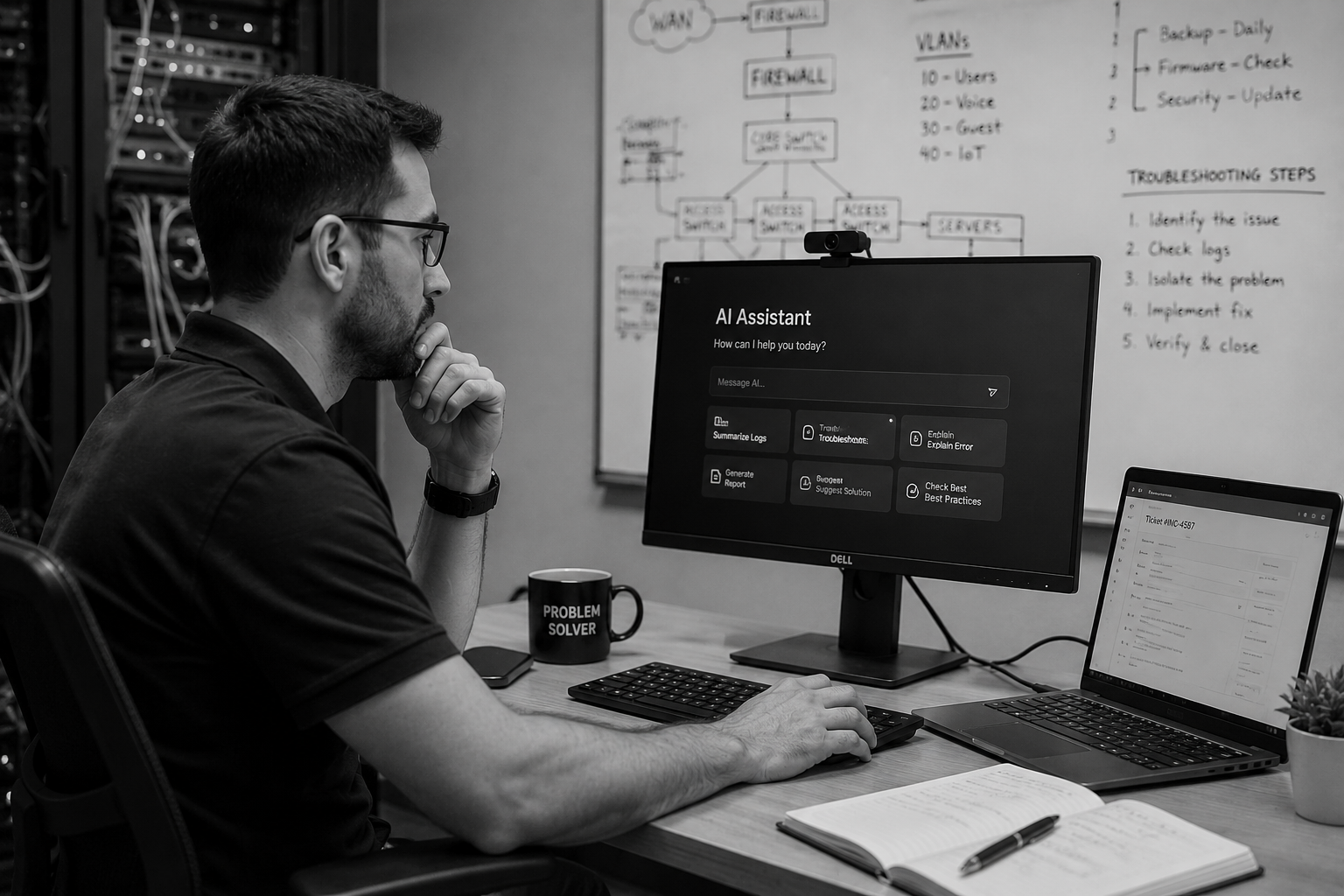
The question underneath almost every offshore staffing conversation in 2026 is one most MSP owners haven't asked out loud yet: if AI is going to handle helpdesk tickets in two years, why am I investing in a remote technician today?
It is a fair question and one that deserves a direct, honest answer rather than either the optimistic dismissal that AI won't affect IT support or the equally unhelpful claim that AI and offshore staffing are perfectly complementary in every scenario. The reality is more specific and more useful than either position. AI is already automating a defined and narrow category of IT support work — the most repetitive, most structured, most predictable tasks at the very bottom of the L1 range. It is not replacing the judgment, communication, client relationship management, and contextual environmental knowledge that characterises the MSP helpdesk function that offshore staffing actually addresses. Understanding where the boundary sits is what makes a sensible staffing decision in 2026.
What the MIT Research Actually Found — And What It Means
In August 2025, Axios reported on MIT's State of AI in Business 2025 project, which found that AI is predominantly replacing outsourced, offshore workers rather than domestic ones. The MIT research contributor quoted in the piece framed it directly: jobs most impacted by AI were already low priority or outsourced. That finding has been cited in offshore staffing discussions as evidence that AI will erode the offshore model — but the specifics of what those "low priority" roles actually involve tells a different story for MSP helpdesk work specifically.
The roles being displaced are the most commoditised, most scripted, most easily automated categories of remote work — basic data entry, simple customer service scripts with defined decision trees, standardised document processing. These are roles where the entire value of the human worker is in executing a fixed procedure that AI can now replicate reliably. They are not the roles that characterise MSP L1 helpdesk work, which involves variable client environments, non-scripted end-user communication, environmental judgment about what is normal versus anomalous, and escalation decisions that require contextual knowledge AI cannot yet replicate reliably at the client-specific level.
The distinction matters because conflating "AI is displacing some offshore work" with "AI will displace MSP helpdesk offshore staffing" produces a conclusion that is not supported by what the technology can currently do — and is unlikely to be supported within the planning horizon of any staffing decision made today.
Where AI Is Actually Helping MSPs Right Now
The honest picture of AI in MSP operations in 2026 is not replacement — it is augmentation of specific functions that genuinely benefit from automation, which frees human technicians for the work that requires judgment.
AI-assisted ticket triage and routing. PSA platforms including ConnectWise, Autotask, and HaloPSA now incorporate AI that reads incoming tickets and suggests priority, category, and routing before a technician reviews them. This does not eliminate the technician — it reduces the time spent on classification and increases the speed with which the right ticket reaches the right person. A Filipino L1 technician using a PSA with AI triage assistance handles more tickets per shift with better routing accuracy than one using the same system without it. The technician's value is in the resolution, the client communication, and the escalation judgment — not in categorising the incoming ticket, which AI does faster and more consistently.
AI-generated knowledge base suggestions. Several RMM and PSA platforms now surface suggested resolution steps from the knowledge base when a technician opens a ticket, based on pattern matching with historical resolutions. This reduces the time a new or offshore technician spends searching for documented procedures and increases first-contact resolution rates. The offshore technician benefits more from this capability than a local senior technician who already has the knowledge base in their head — making AI documentation assistance a direct multiplier on offshore technician effectiveness.
Automated alert noise reduction. NOC functions benefit significantly from AI-powered alert filtering that distinguishes genuine incidents from monitoring noise before a human analyst ever sees the alert. This does not replace the NOC analyst — it means the analyst spends their shift responding to genuine incidents rather than manually filtering the same recurring false-positive alerts that AI can learn to suppress reliably. A Filipino NOC analyst working with AI-assisted alert filtering is more effective per shift than one without it, not redundant because of it.
AI-drafted client communication templates. Some MSPs are using AI tools to generate draft responses to common ticket types that technicians review, personalise, and send. This reduces the time spent on routine communication without removing the human judgment about whether the AI draft accurately describes what was done and what the client needs to know. For offshore technicians for whom writing formal English is a practised skill rather than a native one, AI-drafted templates that they review and adapt can improve communication quality and consistency.
Where AI Cannot Replace the Offshore Technician
The specific capabilities that make MSP helpdesk offshore staffing valuable are the ones that AI handles least reliably in 2026, and the ones where the technology roadmap suggests slow rather than fast improvement.
Client environment specificity. A Filipino technician who has worked a client's ticket queue for six months knows things about that client's environment that no AI system has access to: the network printer that always needs a specific driver reinstallation because of a quirk in the domain controller configuration, the end user who calls every week about the same Outlook sync issue because she keeps changing her password on mobile without updating the desktop client, the server that generates a backup alert every Thursday at 2am because the job was never corrected after a DST change two years ago. This environmental knowledge is stored in the technician's memory and in well-maintained documentation — not in a dataset that AI can be trained on at the client-specific level for a small MSP's individual accounts.
Non-scripted client communication under pressure. The end user who calls at 11pm because their VPN is down before an important 7am presentation is not looking for a scripted resolution path. They are anxious, time-constrained, and need a real person who can assess their specific situation, communicate calmly, try things dynamically based on what they find, and either resolve the problem or manage their expectations with genuine empathy. AI chatbots and ticketing automation handle the scripted version of this interaction adequately. They handle the unscripted, emotionally charged, technically variable version poorly — and MSP clients who get AI-only responses during high-stress incidents reliably report worse satisfaction outcomes than those who reach a competent human.
Escalation judgment in ambiguous situations. The definition of an L1 ticket is that it falls within defined scope. The reality of MSP ticket queues is that a meaningful proportion of incoming work falls in ambiguous territory — tickets that look like L1 but have a detail that makes them L2, alerts that look like noise but have a pattern the RMM's AI filter doesn't recognise. The judgment call about what to attempt, when to stop, and how to escalate in a way that gives the senior engineer the right information is a human judgment function that AI augments but does not replace in complex, variable environments.
The Staffing Model That Uses Both Correctly
The MSPs performing best in 2026 are not choosing between AI tools and offshore staffing — they are using both in the roles each performs best.
| Function | Best Handled By | Where AI Helps | Where Human Offshore Staff Is Essential |
|---|---|---|---|
| Ticket classification and routing | AI-assisted, human reviewed | AI pre-classifies and routes — reduces manual triage time by 40–60% | Reviewing AI classification for accuracy; catching misrouted ambiguous tickets |
| Standard L1 resolution (password resets, account unlocks) | AI automation where fully scripted; human for exceptions | Full automation possible for truly scripted cases — e.g. self-service password reset portals | Any case requiring client communication, identity verification judgment, or environment-specific context |
| Client communication and ticket updates | Human — AI assists drafting | AI draft templates reduce writing time; improve consistency of update language | Review, personalisation, tone judgment, emotionally charged situations |
| NOC alert monitoring and triage | AI filters noise; human triages genuine alerts | AI suppresses known false positives — reduces analyst alert volume by 30–50% | Severity judgment on genuine alerts, initiation of remediation, escalation decisions |
| Escalation decisions | Human — AI provides context | AI surfaces relevant ticket history and knowledge base suggestions to inform the decision | The escalation judgment itself — what to attempt, when to stop, how to package the handoff |
| Overnight coverage and incident response | Human offshore staff — AI assists monitoring | AI alert filtering, automated remediation of scripted responses (service restarts, disk cleanups) | Every situation requiring judgment, non-scripted response, or client communication at any hour |
The pattern in that table is consistent: AI handles the mechanical and the scripted, offshore staff handle everything that requires judgment, contextual knowledge, or human communication. As Worksent's December 2025 analysis of why MSPs are turning to offshore IT outsourcing frames it, AI and automation tools are reducing the number of positions needed for purely routine tasks but are simultaneously increasing the complexity and volume of the work that remains — which is the work that trained human technicians need to handle. The offshore staffing need is not diminishing because of AI. It is evolving — toward technicians who can work alongside AI tools effectively rather than being replaced by them.
The Practical Question for MSP Owners in 2026
The staffing decision an MSP owner makes today is not a five-year commitment. It is a decision about the next twelve to eighteen months of service delivery, with the full expectation that both AI tooling and the offshore staffing model will continue evolving. The question is not whether AI will eventually automate more of what a Filipino L1 technician currently does — it probably will, incrementally, over time. The question is whether that evolution is faster than the staffing problem the MSP owner is trying to solve today.
The overnight tickets are arriving now. The RMM alerts are firing now. The clients expecting 24/7 coverage are asking now. The AI tools that handle those situations autonomously, across variable MSP client environments, with the communication quality clients expect, do not yet exist — and the technology's own research community is candid about this. IBM's AskHR handles 11.5 million standardised interactions annually with minimal human oversight — because the interactions are standardised, the environment is fixed, and the organisation has invested years in tuning the system. An MSP with forty clients across variable environments is not in the same position, and the AI that serves IBM's internal HR function is not the same technology available to a ten-person MSP in Calgary.
The offshore staffing decision made today solves the problem that exists today. If AI tooling advances to the point of genuinely replacing the judgment and communication functions of MSP L1 support — which is a much larger development than the current state of the technology suggests is imminent — that will be visible in advance and the staffing model will adapt accordingly. In the meantime, the Konnect guide on 7 essential tools for managing remote IT support teams covers the specific tool stack that makes offshore technicians most effective in 2026 — including the AI-assisted PSA and RMM capabilities that amplify rather than replace their contribution.
📅 Book a 20-minute call: https://meet.brevo.com/konnectph
✉️ Email us: hello@konnect.ph
If you want to understand how the AI and offshore staffing picture applies to your specific operation — your tools, your clients, your overnight coverage gap — that is exactly the conversation the 20-minute call is built for.
About the Author
Vilbert Fermin is the founder of Konnect, a remote staffing company connecting North American and Australian businesses with top Filipino talent. With deep expertise in IT support and remote team management, Vilbert helps MSPs access skilled technical professionals without the overhead of full-time domestic IT staff. His mission is to showcase Filipino excellence while helping businesses stay protected, productive, and competitive through strategic remote staffing.
Related Resources