How MSPs Are Building Offshore NOC Teams in the Philippines for 24/7 Infrastructure Monitoring
There is a specific gap between what MSPs promise clients and what their monitoring infrastructure can actually deliver overnight. The promise is proactive monitoring — catching issues before clients notice them, responding to alerts before they become outages, maintaining the kind of infrastructure hygiene that justifies a managed services agreement. The reality, for most small and mid-sized MSPs, is that their RMM fires alerts reliably through the night while nobody is actively watching them until someone wakes up, checks their phone, and decides whether the notification warrants getting out of bed.
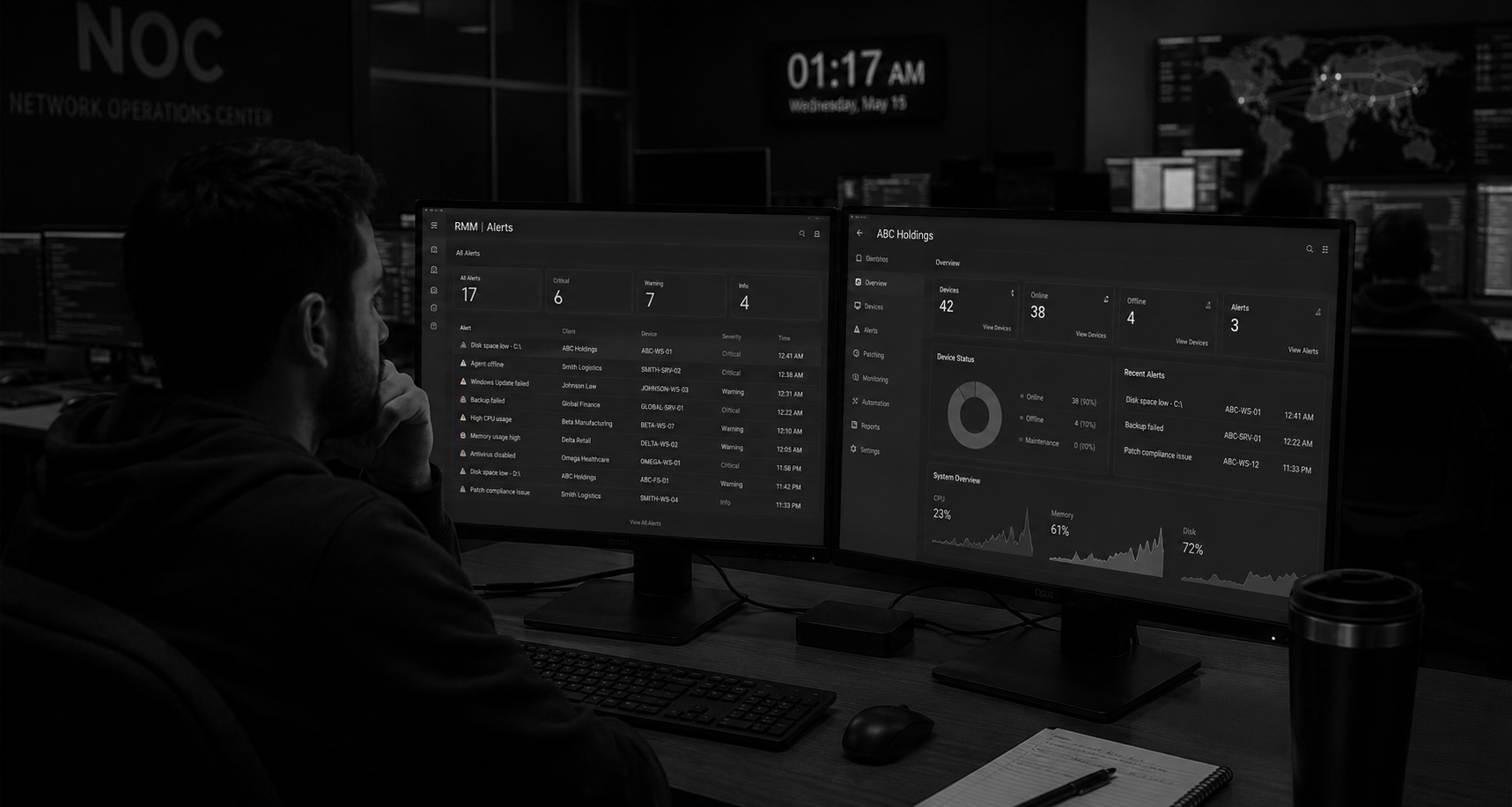
According to the 2026 Kaseya State of the MSP Report, 83% of MSPs say their IT management tools significantly enhance operational efficiency — and that efficiency starts with a NOC function that catches problems before clients notice them. The tools are doing their job. The staffing model is the gap. And it is the gap that the most operationally mature MSPs are now closing with offshore NOC analysts in the Philippines — not through a shared NOC service with pooled resources across dozens of clients, but through dedicated analysts who know their specific client environments and work a normal day shift in Manila while North American clients are sleeping.
What a NOC Actually Does — And Why It Is Different From Helpdesk
The distinction between helpdesk and NOC is worth being precise about because the two functions are sometimes conflated, and the staffing implications are different.
Helpdesk is reactive and user-driven. A client submits a ticket or makes a call. A technician responds, troubleshoots, resolves or escalates. The interaction is initiated by the end user and the quality of the response determines the client's experience of the support function.
NOC is proactive and infrastructure-focused. Nobody calls to report the problem because the NOC's job is to find it before the client knows it exists. The NOC analyst monitors RMM dashboards and alert feeds across all client environments, triages incoming alerts by severity and context, initiates remediation within defined scope, and escalates to a senior engineer when the issue exceeds their authority or capability. As Kaseya's April 2026 NOC guide describes it: in a well-run NOC, all P1 alerts are addressed immediately, remediation is triggered automatically where possible, and escalations occur only when human intervention is necessary. The NOC is the function that makes "proactive monitoring" a real operational capability rather than a marketing claim.
For MSPs managing multiple client environments simultaneously, the NOC function is what allows specialist engineers to focus on complex, high-value work rather than first-level monitoring triage. Without a staffed NOC function — or with one that only operates during business hours — the monitoring tools are generating actionable intelligence that nobody is acting on during the hours when most infrastructure failures begin.
Why Overnight Is When the NOC Matters Most
Infrastructure alerts do not follow business hours. Server backup jobs run overnight. Patch deployments are scheduled for off-peak windows. Network issues that develop slowly during the day often reach alert thresholds after midnight. A storage array that is filling up at 11pm will be at critical capacity by 6am if nobody receives and acts on the alert.
The MSP whose monitoring tool catches every one of these events but whose team doesn't review the alert queue until 8am is not providing proactive monitoring. They are providing next-morning reactive discovery — which is a materially worse service outcome dressed in proactive monitoring language. As Infrassist's November 2025 NOC services analysis documents, P1 alerts need immediate response, and the alert triage that determines what is P1 versus noise requires active human judgment operating in real time, not a review of overnight logs at the start of the business day.
This is the specific operational gap that offshore NOC staffing addresses. A Filipino NOC analyst working a standard Manila day shift — 8am to 5pm Manila time — is actively monitoring RMM dashboards from 7pm to 4am Eastern US time. Every alert that fires in that window has a human analyst reading it, applying the severity framework, initiating remediation within scope, and escalating anything that requires a senior engineer's attention. The overnight monitoring gap closes completely without anyone working a graveyard shift.
The NOC Role: What a Filipino NOC Analyst Actually Does
The NOC analyst role is distinct from L1 helpdesk in ways that affect hiring, tooling requirements, and the operational framework around the engagement. Understanding the specific function helps MSP owners structure the role correctly rather than treating it as interchangeable with helpdesk staffing.
A NOC analyst's core workflow involves monitoring RMM alert feeds across all assigned client environments, applying a severity matrix to incoming alerts — distinguishing genuine incidents from noise based on defined thresholds and business context — initiating first-response remediation within agreed scope, documenting actions taken in the PSA for every alert regardless of outcome, and escalating outside-scope issues through defined escalation paths with complete documentation of what was found and what was tried.
The tools they work in are your existing tools — the same RMM platform your local team uses, the same PSA for ticket logging, the same network monitoring configuration you have already built. As ScalableOS's January 2026 guide to offshore MSP services in the Philippines confirms, Filipino NOC teams are trained to operate in whatever platform the MSP relies on — SolarWinds, PRTG, Nagios, ConnectWise Automate, NinjaRMM, or equivalent — following the MSP's escalation procedures, ticketing flows, and reporting requirements to ensure consistency and continuity. There is no requirement for new tooling. The offshore NOC analyst is an additional person operating within your existing infrastructure.
The difference between a NOC analyst and an L1 helpdesk technician is primarily one of workflow orientation. The helpdesk technician waits for user-initiated contact and responds. The NOC analyst actively watches the monitoring environment and initiates response. Both require English communication quality, tool familiarity, and escalation discipline — but the NOC role requires more structured monitoring methodology and alert triage judgment, and less spontaneous client communication. The hiring profile is slightly different, and the onboarding framework needs to emphasise the alert matrix and escalation runbooks more heavily than it would for a helpdesk technician.
The Runbook: What Makes Overnight NOC Operations Consistent
The operational infrastructure that makes an offshore NOC effective — and that distinguishes high-performing overnight monitoring from an analyst simply watching dashboards — is the runbook library. A runbook is a documented response procedure for a specific alert type: what the alert means, what initial diagnostic steps to run, what remediation actions are within scope, what escalation threshold triggers a handoff, and what documentation the escalation needs to contain.
Runbooks convert overnight NOC work from an exercise in individual judgment to a structured operational process. An analyst with a complete runbook library for the alert types they encounter does not need to decide what to do when a backup job fails at 2am — they follow the defined procedure, document the actions, and escalate if the procedure produces no resolution. The consistency of the response is a function of the runbook quality, not the analyst's individual experience level.
Building the initial runbook library is the most time-intensive part of establishing an offshore NOC function, and it is the investment that pays back most directly in operational quality. ProVal Technologies' May 2026 NOC guidance makes the structural observation that applies here: one of the overlooked benefits of a dedicated NOC structure is improved monitoring discipline — as MSPs grow, monitoring configurations become inconsistent across clients, thresholds vary, alert rules multiply, and documentation lags. The process of building a runbook library for an offshore NOC engagement forces the documentation discipline that benefits the entire operation, not just the overnight monitoring function.
The Cost Comparison That Makes the Case
The financial comparison between building genuine overnight NOC capability locally versus through a Filipino offshore analyst follows the same arithmetic that applies to helpdesk staffing — but with the added dimension that local overnight staffing carries a premium that offshore avoids entirely.
| Coverage Model | Annual Cost (USD) | Coverage Hours | Alert Quality |
|---|---|---|---|
| Owner reviews overnight alerts next morning | $0 direct — high owner time cost | None overnight — reactive next-day discovery | Incidents become outages before response |
| On-call local engineer (phone alerts, voluntary) | On-call premium + burnout cost; $15,000–$25,000 in annualised on-call burden | Inconsistent — response depends on alert severity judgement while half-asleep | Degraded — tired engineers make more errors; on-call burden drives attrition |
| Shared white-label NOC service (third-party) | $1,500–$4,000/month depending on device count; $18,000–$48,000 annually | 24/7 — but pooled resources with limited client environment familiarity | Consistent process; variable quality due to shared team rotation |
| Dedicated Filipino offshore NOC analyst | $8,300–$13,500 USD fully loaded annually | Full overnight window (7pm–4am Eastern on Manila day shift) — no graveyard shift | High — dedicated analyst develops genuine client environment familiarity over time |
ScalableOS's offshore NOC data shows average savings of 70% compared to US hiring for equivalent NOC roles. The cost differential versus even a shared white-label NOC service is significant — a dedicated Filipino NOC analyst at $8,300–$13,500 annually compares favourably with the $18,000–$48,000 annual cost of a shared NOC service, while offering the client environment familiarity advantage that pooled staffing cannot provide.
The Difference Between Dedicated and Shared NOC — Why It Matters
Many MSPs evaluating overnight monitoring solutions encounter white-label shared NOC services — third-party providers who supply pooled NOC staff across dozens of MSP clients simultaneously. These services provide consistent process and genuine coverage but have a structural limitation that dedicated offshore staffing avoids: the technician handling your client's 2am alert has likely never seen that client's environment before.
Client environment familiarity is not a luxury in NOC work — it is the capability that separates genuine proactive monitoring from alert triage by elimination. An analyst who knows that Client A's server farm runs a nightly backup job that generates specific alert patterns between 1am and 3am, and that those patterns are normal, does not escalate them. An analyst seeing that client's environment for the first time applies generic severity criteria and potentially escalates a normal event, waking you up unnecessarily and eroding the on-call arrangement's credibility.
A dedicated offshore NOC analyst, working your environments consistently over months of engagement, develops the same environmental familiarity your local team has — and brings it to the overnight window where shared service providers cannot. The Konnect guide on maintaining service quality across time zones covers how to build the operational framework that produces that consistency — alert matrix documentation, runbook library, weekly calibration reviews — and those same principles apply directly to the NOC function.
What the First 60 Days of an Offshore NOC Engagement Looks Like
The onboarding sequence for a NOC analyst is similar in structure to helpdesk onboarding but with a heavier emphasis on monitoring configuration and runbook familiarisation before any live alert handling begins.
Weeks one and two are access and monitoring review. The analyst gets RMM and PSA access, reviews the alert configuration for each client environment, and learns the severity matrix that determines how different alert types should be prioritised. You walk through the most common alert patterns across your client base — which recurring alerts are noise, which represent genuine incidents, what the standard remediation steps are for the high-frequency event types. This phase produces the initial runbook library entries that the analyst will use during live monitoring.
Weeks three and four introduce supervised live monitoring during business hours — the analyst actively watches the RMM alongside your local team, processes alerts using the runbook framework, and gets feedback in real time on triage decisions and escalation thresholds. This phase is lower risk than overnight live handling and produces rapid learning through immediate feedback.
By week five, the analyst begins overnight monitoring independently, with your local team reviewing the overnight log each morning and providing calibration feedback on any decisions that should have gone differently. By week eight to ten, the overnight monitoring is operating without meaningful management overhead — the morning review of the overnight log takes minutes, escalations arrive as clean documented handoffs, and the RMM alert queue at 8am reflects a night of active monitoring rather than eight hours of unreviewed accumulation.
When to Build NOC Capability vs When to Add Helpdesk First
The order in which MSPs add offshore staffing functions matters. For most small MSPs at early stages of offshore adoption, the helpdesk function — overnight and overflow ticket handling — is the right starting point. Helpdesk work is user-initiated, the scope is more bounded, and the onboarding is faster because the environment knowledge required is built through ticket history rather than monitoring configuration review.
The NOC function becomes the right next step when two conditions are true: the MSP has enough client environments to generate meaningful overnight alert volume, and the MSP has invested in the documentation and runbook infrastructure that makes overnight monitoring operationally consistent rather than dependent on individual judgment. The Konnect guide on how to scale your MSP helpdesk without hiring locally covers the helpdesk-first model in detail. The NOC function is what many MSPs add as the second offshore role once the helpdesk pattern is established and the client base has grown to the point where infrastructure monitoring represents a genuine overnight workload.
If you are an MSP owner with an existing RMM deployment and a client base generating overnight alerts that nobody is actively watching, the NOC analyst conversation is worth having before the next client onboarding adds more environments to the unmonitored overnight window.
📅 Book a 20-minute call:https://meet.brevo.com/konnectph
✉️ Email us:hello@konnect.ph
We work with MSP owners on both the helpdesk and NOC staffing functions — and on the runbook and documentation framework that makes overnight monitoring operationally mature rather than a monitoring-tool subscription with no one watching the dashboard.
About the Author
Vilbert Fermin is the founder of Konnect, a remote staffing company connecting North American and Australian businesses with top Filipino talent. With deep expertise in IT support and remote team management, Vilbert helps MSPs access skilled technical professionals without the overhead of full-time domestic IT staff. His mission is to showcase Filipino excellence while helping businesses stay protected, productive, and competitive through strategic remote staffing.
Related Resources
What Is a Network Operations Center? A Guide for MSPs – Kaseya
When NOC Support Becomes Necessary for Growing MSPs – ProVal Technologies
Maintaining Service Quality Across Time Zones: A Practical Framework for MSPs – Konnect
How to Scale Your MSP Help Desk Without Hiring a Single Local Technician – Konnect