Every MSP owner evaluating offshore staffing eventually arrives at the same shortlist. India is the world's largest outsourcing destination — 1.5 million new engineers annually, massive enterprise IT infrastructure, and decades of established practice. Eastern Europe, particularly Poland, Romania, and Ukraine, is the preferred destination for complex software engineering, with strong technical depth and European time zone compatibility. The Philippines has built the world's leading customer-facing outsourcing industry, handling client communication at scale across financial services, healthcare, telecommunications, and technology support.
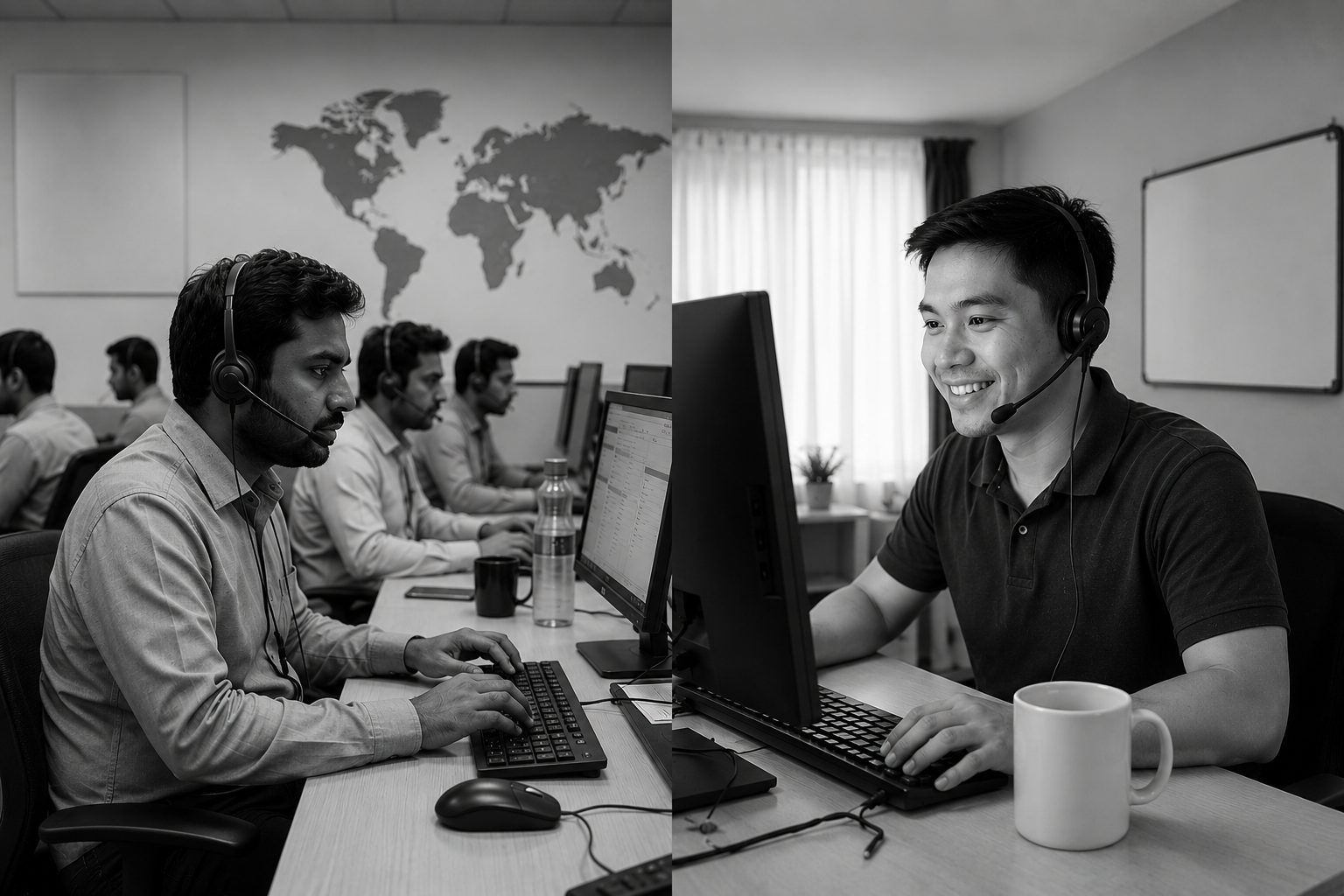
The comparison between these three destinations is not a competition where one wins universally. Each has genuine strengths, and the right choice depends entirely on what you are trying to accomplish. For enterprise software development at scale, India's depth is unmatched. For complex engineering work with European business-hours overlap, Eastern Europe has specific advantages. But for MSP helpdesk and IT support — the specific function that determines whether your clients experience excellent, consistent service at every hour of the week — the Philippines wins on the dimensions that actually matter for your clients and your business. This post explains why, with specificity rather than marketing claims.
The Comparison Framework That Actually Matters for MSPs
Most offshore destination comparisons are built around developer hourly rates, talent pool size, and generic English proficiency rankings. Those metrics matter for software development outsourcing but are not the right framework for MSP helpdesk evaluation. The dimensions that determine whether an offshore helpdesk engagement succeeds for an MSP are more specific: communication quality under pressure with non-technical end users, time zone fit for the client markets being served, cultural alignment with North American and Australian business norms, attrition rates in client-facing roles, and familiarity with the specific tools and workflows the MSP already runs.
Evaluated on those five dimensions, the comparison between the Philippines, India, and Eastern Europe produces a clear picture — not because the other destinations are poor but because they are optimised for different functions than the one MSPs need most.
English Communication Quality: The Dimension That Determines Client Experience
The Philippines has been English-speaking at the institutional level since the American colonial period in the early twentieth century. English is one of two official languages of the Philippines, used in government, education, business, and media. Filipino professionals do not learn English as a second language for work purposes — they grow up in an environment where English is the medium of instruction from primary school through university. The result is a communication style that is natural, idiomatic, and culturally attuned to Western norms in a way that formal second-language English training does not produce.
As Sourcefit's March 2026 comparison of Philippines versus India outsourcing — based on 17 years of operating in both markets — frames it directly: the Philippines leads in customer service, back-office operations, and client-facing roles precisely because of this English quality and Western cultural orientation. India dominates technical IT services and software development, while the Philippines leads in the communication-intensive functions. For MSP helpdesk work, where every interaction with a client involves a non-technical end user who is frustrated and needs a clear, calm, professionally communicative response, this distinction is operationally consequential.
Eastern Europe's English proficiency is strong at the technical level but less consistent at the client-communication level. Polish, Romanian, and Ukrainian engineers who produce excellent code and documentation in English may carry accents and communication styles that feel unfamiliar to North American clients in a voice interaction — not because of any deficiency, but because their English training has been oriented toward technical documentation and collaboration rather than client-facing communication in Western English. For engineering work where most interaction is written and asynchronous, this is irrelevant. For live client support in an MSP helpdesk context, it matters.
Time Zone Fit: Where Each Destination Actually Works
The time zone dimension is the most consequential operational factor and the one where the Philippines has the most unique positioning for the specific markets Konnect serves.
For Australian MSPs, the Philippines (UTC+8) aligns almost perfectly with Australian eastern business hours. A Manila day shift covers Sydney and Melbourne clients during their business day without any overnight or shift premium arrangement. No other offshore destination offers this alignment for Australian businesses — India (UTC+5:30) requires a morning Philippine time shift to cover Australian afternoons, and Eastern Europe (UTC+1 to UTC+3) is so far removed from Australian time that useful overlap essentially does not exist.
For US and Canadian MSPs, the Philippines occupies the unique position of a normal Manila business day falling precisely in the North American overnight window — 7pm to 4am Eastern on a standard Manila shift. This makes genuine staffed 24/7 coverage possible without any graveyard shift arrangement. The Filipino technician is working a normal weekday when your US clients are sleeping, and your overnight queue is being handled by someone alert, rested, and operating at full capacity. India's time zone (UTC+5:30) produces a similar overnight coverage window for US MSPs, but with the communication quality differences noted above. Eastern Europe's time zone creates morning overlap with US East Coast hours — useful for some functions but not the overnight coverage window that solves the MSP owner's primary pain point.
GoGloby's March 2026 offshore staffing comparison makes the structural observation that applies here: when comparing countries, checking overlap hours with your home team, noting public holidays, and examining typical attrition rates produces better sourcing decisions than headline hourly rates alone. On all three of those factors — time zone overlap, holiday calendar, and attrition — the Philippines outperforms the alternatives for MSP helpdesk purposes.
Cultural Alignment: The Factor That Determines Long-Term Team Integration
Cultural alignment in offshore staffing is not about surface-level similarities — it is about whether the working relationship, the management expectations, and the communication style between the MSP owner and the offshore technician produces a functional, sustainable team dynamic over time.
Filipino work culture has been shaped by decades of close commercial and cultural relationship with North America. American television, music, business culture, and management norms are deeply familiar to Filipino professionals in a way that produces natural cultural fit with North American MSP owners. The expectations around professional communication, client service orientation, responsiveness, and workplace hierarchy that North American managers bring to an employment relationship are ones Filipino professionals understand implicitly rather than adapting to.
Indian IT culture is excellent for structured, large-scale technical delivery but carries different norms around hierarchy, communication indirectness, and the management relationship that can create friction in the kind of small-team, high-context MSP engagement where a single technician needs to exercise independent judgment, escalate appropriately without being asked, and communicate proactively with clients. These are not universal characterisations — they are tendencies that show up in the staffing literature and that Sourcefit's 17-year comparative experience specifically documents as relevant to client selection between the two destinations.
Eastern European professionals bring strong technical culture but different interpersonal norms shaped by European rather than American professional culture. For an Australian or Canadian MSP owner managing a solo offshore technician who will be representing their brand to clients, the cultural fit with a Filipino professional is typically smoother and requires less deliberate management investment than either the Indian or Eastern European alternatives.
Attrition and Retention: The Dimension Most Comparisons Skip
The attrition picture for client-facing roles in each offshore destination is one of the most practically consequential differences and the one most frequently omitted from destination comparisons that focus on cost and technical capability.
India's BPO and IT support sector carries one of the highest attrition rates globally for client-facing roles — figures consistently reported in the 30–40% annual range for call centre and helpdesk functions. This is driven by the massive size of the domestic IT labour market, competitive salary poaching between employers, and the use of entry-level support roles as stepping stones to higher-paying technical positions. For MSP owners who need a technician to develop genuine familiarity with their specific client environments over months of engagement, 40% annual attrition is a structural problem regardless of the quality of the individual hire.
Eastern Europe's attrition in IT support roles is lower than India's but carries a different risk — geopolitical instability in key markets. Ukraine, which was a major Eastern European outsourcing hub before 2022, has experienced significant disruption. Poland and Romania remain stable, but the concentration of risk in a smaller number of markets creates a vulnerability that the Philippines, with its mature and geographically distributed outsourcing infrastructure, does not share.
The Philippines' client-facing support sector attrition, in well-structured foreign employer engagements, runs significantly below the BPO industry average of 30–40%. As the Konnect guide on why Filipino professionals stay documents, the cultural factors that drive retention in Filipino remote work relationships — the value placed on stable foreign employment, the sense of professional pride and loyalty to good employers, and the family-oriented career motivation that makes stability a primary objective — produce retention outcomes that the other offshore destinations do not match for this specific role type.
The Head-to-Head Comparison
| Dimension | Philippines | India | Eastern Europe |
|---|---|---|---|
| Client-facing English communication | Excellent — native-level idiomatic English, Western cultural orientation | Good — strong technical English, variable client communication quality | Good — strong technical English, less client-communication-oriented |
| Time zone for Australian MSPs | Excellent — UTC+8, near-perfect alignment with AEST | Moderate — UTC+5:30, requires shift adjustment for full AU overlap | Poor — UTC+1 to +3, no viable AU business hours overlap |
| Time zone for US/Canada overnight coverage | Excellent — Manila day shift covers NA overnight naturally | Good — similar overnight window but communication quality trade-off | Moderate — morning overlap with US East Coast only |
| Cultural alignment with NA/AU managers | Excellent — deep familiarity with Western norms, proactive communication style | Good — requires more deliberate management investment for small-team fit | Good — European professional norms, less NA cultural familiarity |
| Attrition in client-facing roles | Low — well-structured engagements average 38-month tenure | High — 30–40% annual in BPO/support roles, competitive poaching market | Moderate — lower than India, geopolitical risk in some markets |
| MSP tool familiarity (PSA, RMM) | Strong — large existing base of professionals with ConnectWise, NinjaRMM, Autotask experience | Strong — large IT workforce with enterprise tool experience | Moderate — less exposure to North American-specific MSP tooling |
| Cost at L1 helpdesk level | Low — $7,000–$13,000 USD annually fully loaded | Low — similar range; $25–$35/hr for experienced roles | Moderate — $20–$50/hr range; typically higher than Asia for equivalent roles |
| Best fit for | MSP helpdesk, client-facing support, NOC, L1/L2 | Enterprise IT, large-scale software development, back-office processing | Complex software engineering, cybersecurity, EU-timezone senior roles |