The most common concern MSP owners raise after their offshore engagement is running — not before, but after — is not about the technician's technical ability. It is about consistency. The technician handles tickets well during the supervised onboarding period. The quality is clearly there. But as independent operation begins and the overnight queue runs without oversight, the question that surfaces is whether the work being done at 2am Manila time is being done to the same standard as the work done at 2pm local time with a senior tech in the next Slack channel.
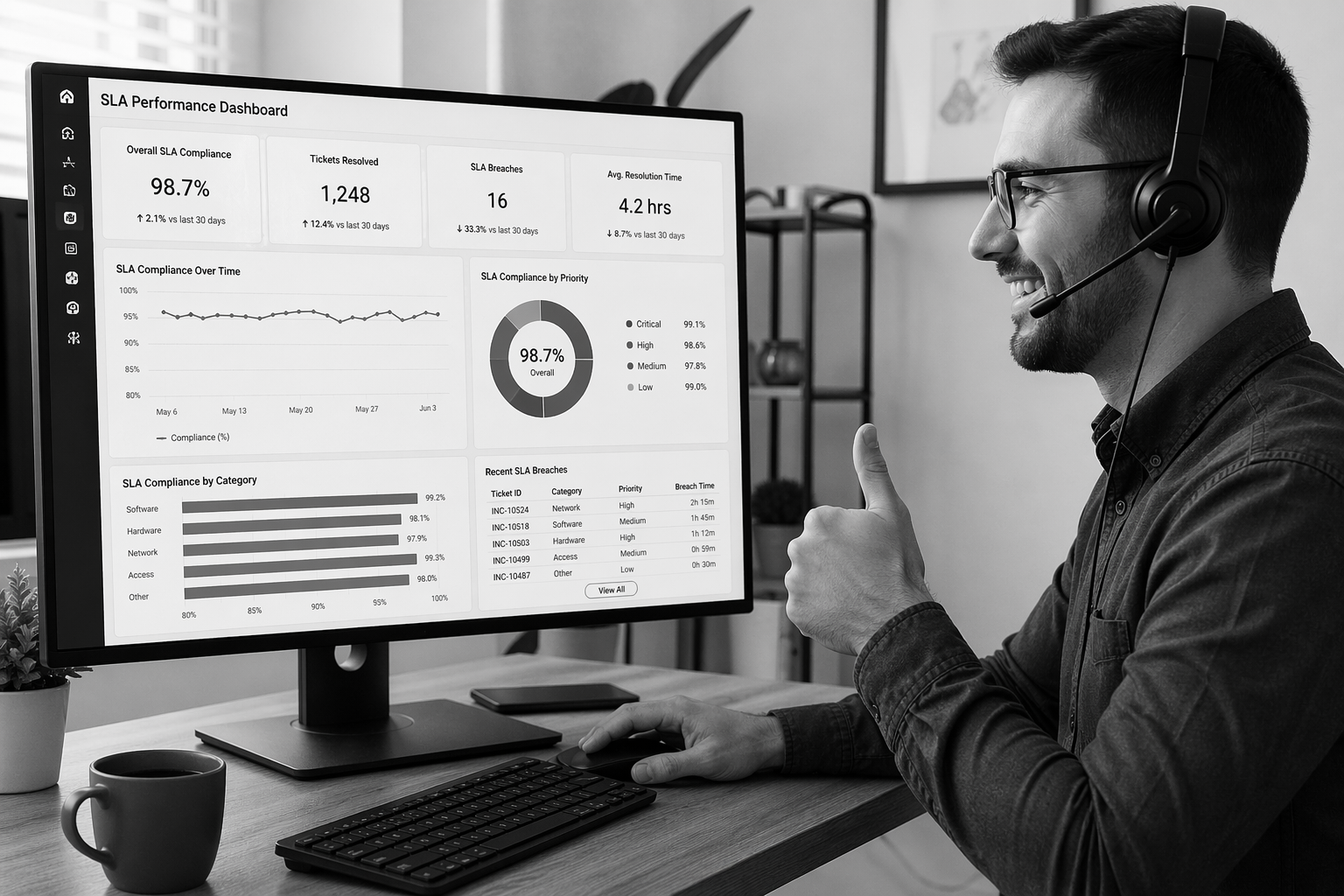
It is the right question to ask, and it has a structural answer rather than a personality-based one. Service quality across time zones is not primarily a function of who the offshore technician is — it is a function of whether the operational infrastructure exists to produce consistent outcomes regardless of who is handling a ticket or when. The MSPs who maintain identical SLA performance across their entire coverage window — local and offshore, business hours and overnight — do so because they have built systems that make consistency the path of least resistance. The MSPs who experience quality drift between time zones almost always have the same root problem: the systems that define what good looks like were never made explicit enough for someone to follow them independently.
This post gives you the operational framework that closes that gap.
Why Quality Drift Happens Across Time Zones
Before building the framework, it helps to understand the specific mechanisms through which quality drift occurs in distributed MSP teams. According to LTVplus's 2026 MSP SLA management analysis, when tech teams cannot clearly see which tickets are approaching SLA deadlines or which require immediate action, they guess — and deadlines become reactive rather than managed. That dynamic is amplified in an overnight or offshore context because the usual informal signals that keep local teams aligned — seeing a colleague's ticket queue, overhearing an escalation, noticing that a senior tech is concerned about a particular issue — do not exist across a time zone gap. The offshore technician is operating in an information environment defined entirely by what the formal systems surface and what the documentation says. If those systems and documentation have gaps, quality drift fills them.
The three most common gaps are predictable. The first is undefined ticket standards — the absence of an explicit definition of what a complete, well-handled ticket looks like, so the offshore technician defaults to their own judgement about what constitutes adequate documentation, resolution communication, and escalation framing. The second is invisible SLA timers — tickets enter the queue but the technician has no real-time visibility into which are approaching SLA breach, so triage becomes intuitive rather than data-driven. The third is missing escalation confidence — uncertainty about what falls within L1 scope versus what requires escalation, which produces either over-escalation (interrupting you unnecessarily) or under-escalation (attempting work that should have been handed off). All three gaps are fixable with the right infrastructure.
The Five Components of a Time-Zone-Proof Quality Framework
Component one: a written ticket quality standard with examples. The most important document in your quality framework is a one-to-two page description of what a well-handled ticket looks like at your MSP — covering the initial response communication, the documentation of steps taken, the escalation handoff format, and the closure note standard. This document should include a worked example of a good ticket and a worked example of a poor one, so the standard is concrete rather than abstract. Without this document, every technician — local or remote — applies their own interpretation of quality. With it, the standard is explicit and reviewable. The Jestor January 2026 ITSM trends analysis identifies a comprehensive knowledge base as one of the highest-leverage investments an IT organisation can make, specifically because it enables consistent resolution quality across time zones. The ticket quality standard is the foundation of that knowledge base.
Component two: PSA-configured SLA timers visible to all technicians. Your PSA's SLA timer functionality exists to make the breach risk visible before it materialises, not as a reporting tool after the fact. If your offshore technician cannot see at a glance which tickets in the queue are approaching their response or resolution deadlines, they are triaging by feel rather than by data. Configure your PSA so that SLA status is prominently displayed in the ticket queue view — colour-coded by urgency, sorted by time remaining, with automated alerts when a ticket crosses a defined warning threshold. According to the LTVplus MSP SLA management framework, configuring your PSA to automatically assign priority levels based on issue type, affected systems, and client SLA tier — and routing tickets to the appropriate queue based on skillset and current workload — reduces manual triage time and ensures critical tickets reach the right person within seconds. For an overnight offshore technician working without a local team to sense-check priorities, automated priority visibility is not a nice-to-have. It is the mechanism that keeps SLA compliance consistent.
Component three: a tiered escalation matrix with clear scope boundaries. NinjaOne's December 2025 guide on building escalation paths for 24/7 MSP teams identifies three key indicators that an escalation matrix is working: tickets escalate within SLA timelines, the number of stalled or misrouted tickets drops, and technician feedback confirms the process is clear. All three indicators depend on the escalation matrix being specific enough to follow without ambiguity. A matrix that says "escalate complex issues to senior tech" is not a matrix — it is an instruction that requires a judgement call every time it is applied. A matrix that says "escalate any ticket involving domain controller access, security incidents, firewall configuration changes, or client hardware failures to [specific escalation contact] via [specific channel] within [specific timeframe]" is a matrix that produces consistent escalation behaviour regardless of who is reading it or what time it is.
Component four: asynchronous daily handoff documentation. The shift handoff is the moment where quality consistency is most at risk — the transition between the local team finishing their day and the offshore team taking the overnight queue, and again when the offshore team finishes and the local team picks up in the morning. Without a structured handoff, the incoming team has no context on what happened while they were offline: which tickets are in progress, which clients are in an elevated state, which escalations are pending, what was tried and what wasn't. The handoff document does not need to be long — a five to ten minute exercise at the end of each shift, covering open tickets with status, any client situations that need morning follow-up, and any escalations that occurred. Over time this document becomes the institutional memory of overnight operations and the primary tool for maintaining continuity of quality across the shift boundary.
Component five: weekly ticket review as a quality calibration tool. The fastest way to close quality gaps before they become patterns is to review a sample of the previous week's offshore tickets in a structured weekly conversation with the technician — not to audit or criticise, but to calibrate. Where did the technician's judgement differ from what you would have done? Were there escalation decisions that should have gone differently? Were there ticket notes that lacked information that would have been useful? This weekly review serves two functions simultaneously: it identifies specific documentation or standard gaps that need to be addressed, and it gives the offshore technician direct feedback on their performance in a format that Filipino professionals respond to particularly well — specific, constructive, and delivered with respect rather than in a public or high-pressure context.
The Metrics That Tell You Whether It Is Working
Quality across time zones is not subjective — it is measurable, and the measurement framework should be established before the offshore engagement begins so you have a baseline to compare against.
| Metric | What It Measures | Target Benchmark | Warning Sign |
|---|---|---|---|
| First Response Time (FRT) — offshore hours | How quickly tickets are acknowledged during offshore coverage window | At parity with or better than local team FRT | FRT during offshore hours consistently exceeds local team average by more than 20% |
| First Contact Resolution Rate (FCR) | Percentage of L1-scope tickets resolved without escalation | Above 70% for standard L1 ticket types | High escalation rate on ticket types that should be within L1 scope — signals documentation gap |
| SLA breach rate — offshore hours | Percentage of tickets that breach SLA commitments during offshore coverage | At parity with local team breach rate | Breach rate during offshore hours exceeds local team rate — signals triage or priority visibility problem |
| Escalation quality score | Completeness and accuracy of documentation in escalated tickets | Senior tech can act on escalation without requesting additional information | Escalations regularly arriving without sufficient context — signals ticket standard or training gap |
| Ticket note quality rate | Percentage of closed tickets with complete notes meeting your defined standard | Above 90% against your ticket quality standard document | Consistent note gaps in specific ticket types — target those types in the next weekly review |
According to the ScalePad 2026 MSP Trends Report, 60% of MSPs now have a formal customer success program — a recognition that reactive support alone cannot sustain growth. The metrics above are the operational foundation of any meaningful customer success program, and tracking them consistently across both local and offshore coverage hours is what converts the concept of quality consistency into a verifiable claim rather than an aspiration.
The Tool Stack That Makes This Manageable
None of the five framework components above requires new tooling if your current stack includes a modern PSA and RMM. What it requires is configuration discipline — using the tools you already have in ways that enforce consistency rather than leaving quality to individual judgement.
Your PSA is the primary quality enforcement tool. SLA timer configuration, automatic priority assignment, ticket routing rules, and the note templates that structure what information is captured at each stage of ticket handling — all of these are PSA configuration decisions that produce quality consistency without requiring the offshore technician to remember rules that are not visible in their workflow. Configure the PSA so that doing the right thing is the easiest path, not a memory exercise. Your RMM is the escalation enabler — complete remote access and accurate system information mean the offshore technician can attempt and document troubleshooting steps that actually move the ticket forward rather than stalling while waiting for access or context. Your communication tool — Slack, Teams, or equivalent — is where the handoff document lives and where the weekly review happens. The formality of the channel matters less than the consistency of the practice.
The Konnect guide on 7 essential tools for managing remote IT support teams covers the specific tool recommendations for MSPs managing offshore staff in more detail, including how to configure the integration between PSA, RMM, and communication tools for a distributed team. The short version is that the tool stack for managing an offshore team is the same stack you are already running — the difference is in how deliberately it is configured to surface the information the offshore technician needs to do their job to your standard without needing to ask.
What Consistent Quality Actually Feels Like at 90 Days
By the end of a well-structured 90-day period, quality consistency across time zones is no longer something you are actively managing — it is something the system produces. You review the weekly metrics and the overnight SLA performance looks like a horizontal line, not a sawtooth. The weekly ticket review is getting shorter because there are fewer gaps to discuss. Escalations arrive with complete information and you can action them without a follow-up question. The handoff document from the overnight shift gives you a clean picture of what happened while you were offline.
The offshore technician at that point is not a coverage layer you are monitoring nervously. They are a working part of the team whose output is consistent with your standard because the standard is documented, visible in the tools, and reinforced weekly. The time zone is a logistics detail, not a quality risk.
That outcome is available to any MSP owner willing to invest the preparation time the five components above require — most of which is one-time setup rather than ongoing overhead. The MSPs who experience quality drift across time zones are the ones who deployed an offshore technician into an underdefined operational environment and then wondered why the results were inconsistent. The framework prevents that outcome, and it does so before the first overnight ticket is handled.
📅 Book a 20-minute call: https://meet.brevo.com/konnectph
✉️ Email us: hello@konnect.ph
We walk through the quality framework with every MSP we work with before their offshore engagement starts, so the operational infrastructure is in place before the first ticket lands in the overnight queue.
About the Author
Vilbert Fermin is the founder of Konnect, a remote staffing company connecting North American and Australian businesses with top Filipino talent. With deep expertise in IT support and remote team management, Vilbert helps MSPs access skilled technical professionals without the overhead of full-time domestic IT staff. His mission is to showcase Filipino excellence while helping businesses stay protected, productive, and competitive through strategic remote staffing.
Related Resources