Most MSP conversations about service models treat co-managed IT and fully managed services as two distinct offerings competing for the same clients. The more useful frame is to think of them as two different client relationships serving two different business problems — and to recognise that the most capable MSPs in 2026 are positioned to deliver both, often with the same underlying team structure.
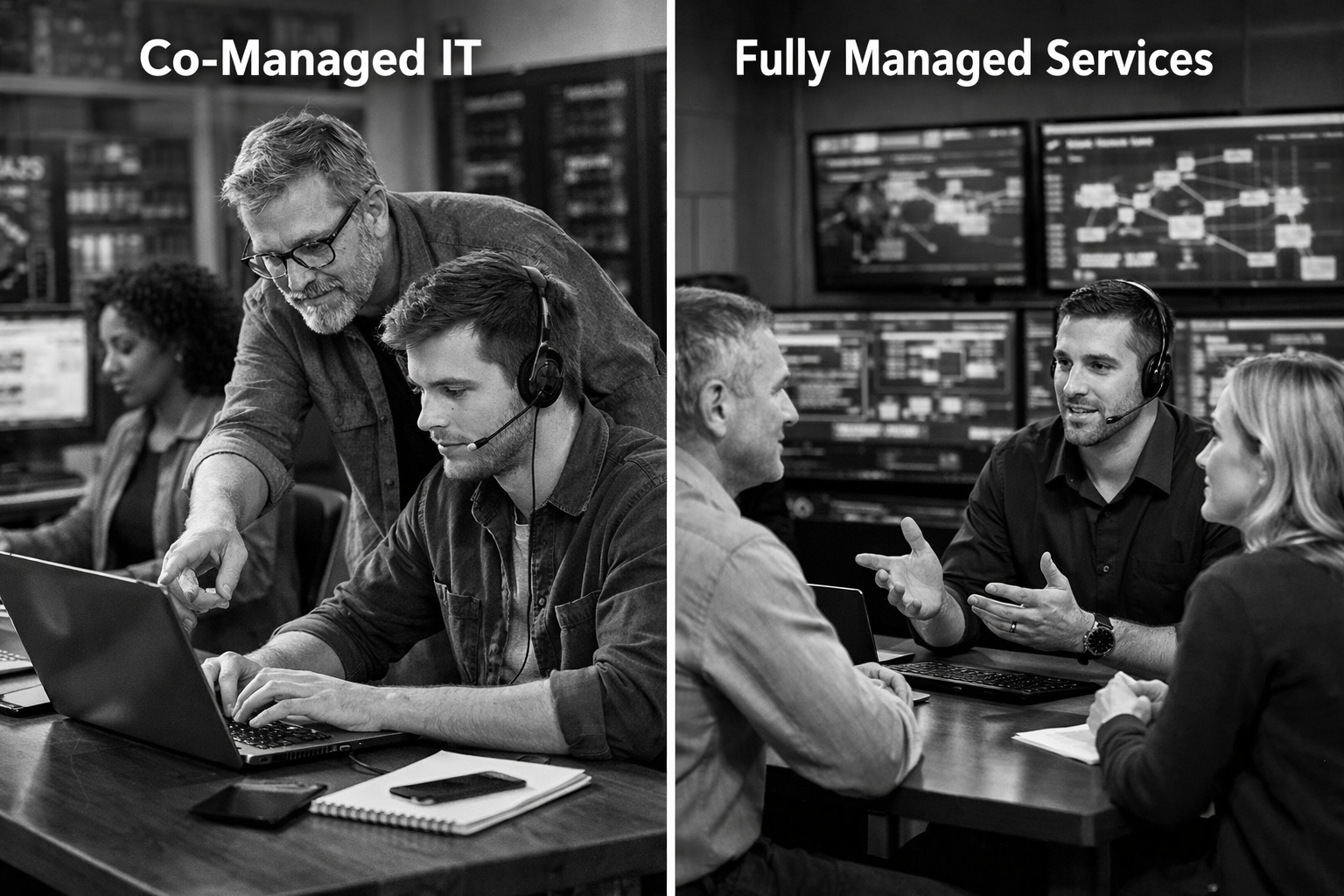
The distinction matters practically because it determines how you price, how you staff, what you promise on SLAs, and what your growth ceiling looks like. It also determines where offshore staffing fits into your delivery model — and the answer is different for each. Getting the model choice right for each client type is one of the more underappreciated strategic decisions in MSP operations, and it is increasingly consequential as the market matures and client expectations continue rising.
What Each Model Actually Means
The definitions circulate widely but are worth stating precisely because the language is used loosely in the industry, and loose definitions create misaligned expectations with clients.
Fully managed services means the MSP assumes complete responsibility for a client's IT function. There is no internal IT staff on the client side with meaningful technical capability — or if there is, they are not involved in day-to-day IT decisions. The MSP is the IT department: monitoring, helpdesk, infrastructure management, security, strategic advisory, vendor management, and everything between. The client's relationship with IT is entirely mediated through the MSP. This model suits SMBs without internal IT resources, organisations where the founder or operations manager has been filling the IT role personally, and businesses that have decided IT is not a core competency they want to develop internally.
Co-managed IT means the MSP works alongside an existing internal IT person or team, filling specific gaps rather than replacing the entire function. The internal IT staff handles what they handle — typically the work they know well, the day-to-day user relationships, and the strategic knowledge of the business — while the MSP provides the capacity, tooling, specialisation, or coverage hours that the internal team cannot sustain alone. A mid-market company with an IT Director who is drowning in password resets and patch management while trying to run a cloud migration is the prototypical co-managed client: technically capable internally, structurally overwhelmed. As Compass MSP's January 2026 analysis notes, co-managed IT is designed for businesses already with an IT leader but facing capacity burnout — someone who knows the business processes intimately but is overwhelmed by the operational load.
The Market Data That Makes Co-Managed Too Important to Ignore
The growth of co-managed IT as a service model has accelerated significantly. According to the ScalePad 2025 MSP Business Trends Report, 83% of MSPs now offer co-managed IT, allowing them to integrate with internal IT teams rather than replacing them entirely. This near-universal adoption rate signals that co-managed has moved from a niche offering to a standard component of the MSP service portfolio.
The retention data is equally compelling. MSP industry benchmarking data from Service Leadership shows that MSPs offering co-managed IT and vCIO services have client churn rates under 5% — compared to the 8.4% industry average. That gap in retention reflects something real about the co-managed relationship: clients who have both internal IT capability and a trusted external partner are more deeply embedded in the service relationship than clients receiving commodity helpdesk support alone. Replacing a co-managed MSP requires not just finding a new provider but dismantling a working collaboration between the internal team and the external team — a much higher switching cost than simply moving a support contract.
For MSPs thinking about which clients to pursue and how to price their relationships, that retention differential is worth taking seriously. A co-managed client relationship that stays for six years generates materially more lifetime value than a fully managed SMB relationship with 8.4% annual churn, even if the monthly recurring revenue is similar.
The Operational Differences That Actually Matter
The model difference is not just a positioning distinction — it produces meaningfully different operational realities on both sides of the relationship.
In a fully managed engagement, the MSP owns the entire client experience with no internal technical counterpart. Every escalation, every urgent call, every strategic question comes to the MSP. Clients with no internal IT capability expect more hand-holding, more communication, and more proactive guidance than a co-managed client whose internal IT lead can filter, triage, and contextualise on their behalf. Fully managed clients tend to generate more L1 volume per user because there is no internal first line — every end-user IT problem becomes an MSP ticket. The service delivery model needs to be able to absorb that volume without the cost structure becoming unsustainable.
In a co-managed engagement, the internal IT person acts as a natural filter and first line. Many end-user problems are handled internally before they ever reach the MSP. What reaches the MSP is the overflow, the specialised work, and the problems that exceed the internal team's scope. This means lower ticket volume per user but higher average ticket complexity — the MSP's team is handling the things the internal person cannot, which skews toward L2, L3, project work, and strategic advisory. The relationship is closer to a partnership than a vendor arrangement, which changes the communication dynamic significantly.
| Dimension | Fully Managed | Co-Managed |
|---|---|---|
| Client IT capability | None or minimal — MSP is the IT department | Internal IT person or team exists; MSP supplements |
| Typical ticket profile | Higher L1 volume; all end-user issues reach MSP | Lower L1 volume; internal team filters first; MSP handles complex overflow |
| Relationship type | Vendor/provider — MSP delivers, client receives | Partnership — MSP and internal team collaborate |
| Pricing model | Per-user all-inclusive; typically $150–$400/user/month | Modular — priced on specific services provided, tooling access, and escalation scope |
| Client churn risk | Higher — easier to switch providers at contract renewal | Lower — switching disrupts internal team workflows and institutional knowledge |
| Growth path | Add more SMB clients; scale through volume | Move upmarket; deeper relationships with fewer, larger clients |
Where Offshore Staffing Fits — And It Is Different for Each Model
Offshore staffing plays a different role depending on which model you are running, and understanding that difference determines how you structure the offshore engagement.
In a fully managed model, the primary offshore staffing use case is L1 coverage capacity — particularly for after-hours, overnight, and overflow volume. Fully managed clients generate consistent L1 ticket volume across all hours, and that volume needs to be absorbed without the cost of maintaining a full local team through the night. A Filipino L1 technician covering overnight hours for your fully managed client portfolio on a Manila day shift is the structural fit that makes fully managed 24/7 coverage economically viable for a small MSP. Without it, genuine 24/7 coverage requires either local overnight staff at significant cost or owner on-call arrangements that are unsustainable at scale.
In a co-managed model, the offshore staffing use case shifts. Your co-managed clients already have an internal first line — you are not the primary L1 layer. What those engagements need from your MSP is reliable escalation coverage, specialised tooling and expertise, and capacity for the overflow that the internal team cannot handle. An offshore technician in a co-managed context might be handling specific project deliverables, running patch management and monitoring tasks that the internal team delegates, or providing first-response during hours when the internal IT person is unavailable. The ticket type profile is different and the required skill level is often higher than pure L1 — which means the offshore engagement for co-managed clients may warrant a more senior or more specialised technician than the standard L1 hire.
The Coevolve February 2026 analysis of managed versus co-managed services finds that effective implementation of managed services has the potential to increase operational efficiency by 45–65% while reducing IT costs by 25–45% — figures that apply to both models but require the right staffing structure to realise. The operational efficiency gains specifically come from having the right people doing the right work at the right cost, which is precisely what a well-structured offshore layer enables.
The Client Fit Question That Most MSPs Skip
The model comparison question is usually framed as "which model is better?" The more useful question is "which clients are right for which model?" — and answering that correctly is what lets an MSP run both without the tension between them becoming operational chaos.
Fully managed clients are typically: SMBs under 50 employees without dedicated IT headcount, founder-led businesses where the owner has been filling the IT role and is ready to hand it off entirely, and organisations in industries without significant compliance complexity where standardised tooling delivers adequate coverage. The fully managed relationship is often the entry point for clients who will eventually grow into co-managed arrangements as they hire internal IT talent.
Co-managed clients are typically: Mid-market organisations with 50–500 employees, companies with an internal IT Director or team who are competent but understaffed for their environment's complexity, businesses in regulated industries where the internal team owns compliance relationships but needs specialist support, and organisations that have specific areas of IT they want to retain internally for business or cultural reasons.
The MSPs that struggle with co-managed engagements are usually those who have applied the same service delivery model they use for fully managed clients — the same SLA structure, the same communication cadence, the same tooling access model — to a co-managed relationship where the client has internal capability and different expectations. The co-managed client's internal IT person does not want to be treated like an end-user submitting tickets. They want to be treated as a peer whose escalations get handled with the same technical seriousness they are bringing to the conversation.
The Positioning That Makes Both Models Work
The MSPs that run both models successfully — and there are many, given the 83% adoption of co-managed across the industry — do so by being explicit about the distinction in their sales and service delivery processes. They know which clients are in which model, they price accordingly, they staff accordingly, and they never confuse the two engagement types.
The Konnect post on how MSPs can offer 24/7 support without burning out their team covers how offshore staffing specifically enables 24/7 coverage in the fully managed model — which is the most common place small MSPs hit their capacity ceiling. For MSPs offering or considering co-managed services, the question of how offshore staffing fits into the delivery model is worth thinking through before structuring the first co-managed engagement, because the role and skill level of the offshore technician may need to be different from what you are using on the fully managed side.
Both models are viable. Both are growing. And the MSPs who understand the operational and staffing implications of each — rather than treating them as interchangeable — are the ones building practices that scale without the friction that comes from applying one model's logic to the other's client relationships.
If you are an MSP owner thinking through which model fits your current client base or your intended growth direction, and you want to understand how offshore staffing fits into that picture specifically:
📅 Book a 20-minute call: https://meet.brevo.com/konnectph
✉️ Email us: hello@konnect.ph
We work through the service model and staffing structure question with every MSP we engage with, because getting that alignment right is what makes the offshore engagement perform as it should.
About the Author
Vilbert Fermin is the founder of Konnect, a remote staffing company connecting North American and Australian businesses with top Filipino talent. With deep expertise in IT support and remote team management, Vilbert helps MSPs access skilled technical professionals without the overhead of full-time domestic IT staff. His mission is to showcase Filipino excellence while helping businesses stay protected, productive, and competitive through strategic remote staffing.
Related Resources