Building a Remote Team Culture Across Time Zones: A Guide for MSPs with Offshore Staff
There is a specific moment that separates the MSP owners who build durable offshore teams from those who cycle through them. It usually happens somewhere between month three and month six. The operational structure is working — tickets are being handled, handoffs are clean, SLA performance is consistent. And then something happens that reveals whether the culture underneath the operations is real or assumed. A small misunderstanding escalates in a way it shouldn't. A milestone goes unacknowledged. The technician's responses become a little more perfunctory. The engagement that was working fine starts to feel like it is only working fine.
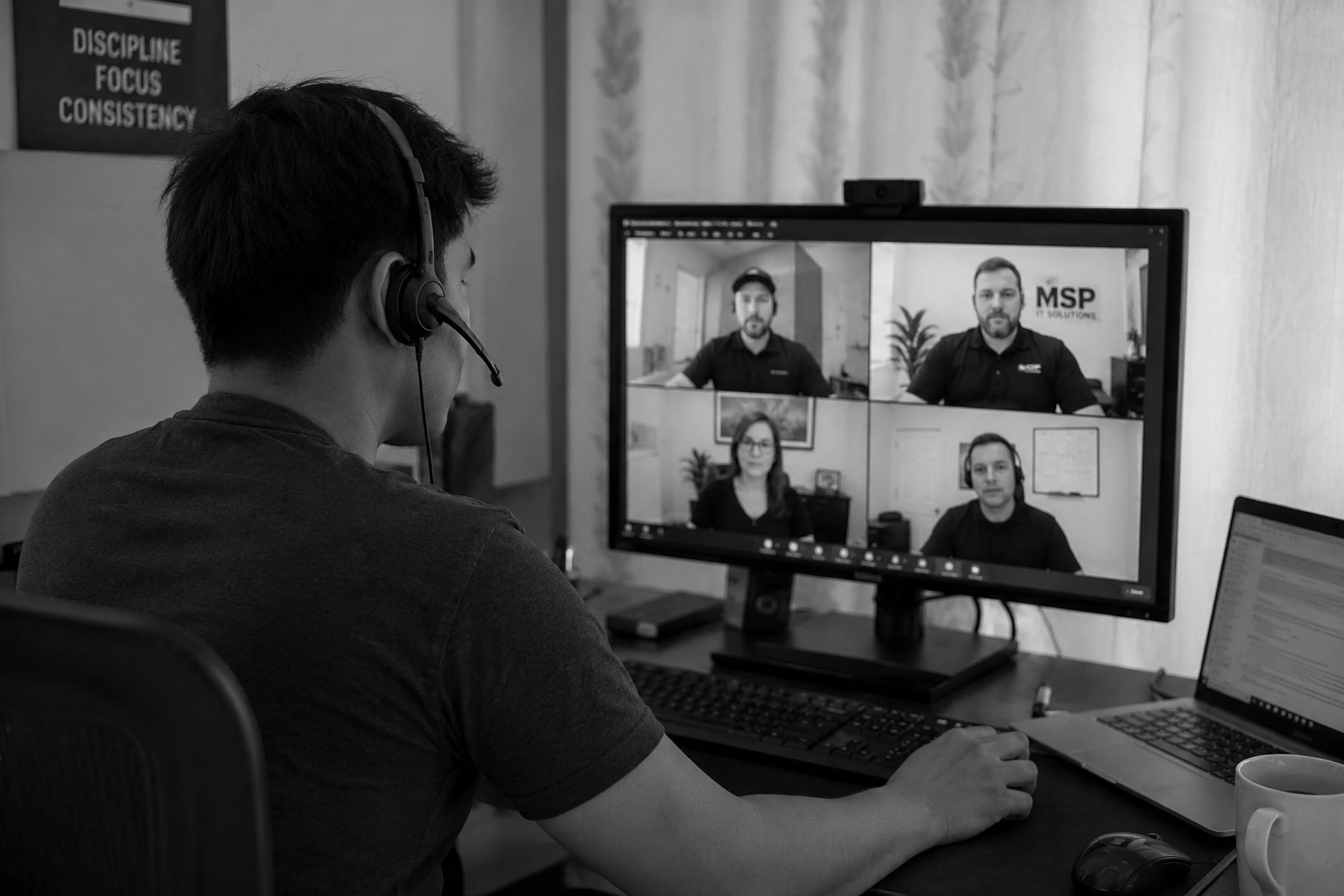
The operational layer of offshore staffing is well-documented — access provisioning, documentation standards, shift handoffs, escalation protocols. The cultural layer is harder to name and easier to skip, because it doesn't produce a visible failure in the short term. What it produces instead is a slow drift — in engagement, in proactivity, in the quality of the technician's discretionary effort, and eventually in the retention number that shows up as a departure six or twelve months earlier than it should have.
Gallup's 2025 State of the Global Workplace research surfaced what it called a remote work paradox: fully remote workers report the highest engagement rates at 31%, compared to other work arrangements, but those same workers report higher rates of stress, loneliness, and burnout than their hybrid or on-site counterparts. The engagement is real. So is the isolation risk. For MSP owners managing a Filipino technician across a significant time zone gap, that paradox is the cultural problem to design around — not through perks or wellness programs, but through the deliberate management practices that make remote engagement genuine rather than procedural.
Why Culture Cannot Be Assumed in a Distributed Team
In a co-located team, culture forms through proximity. The new hire picks up norms by watching how their colleagues interact, overhears how the senior tech handles a difficult client call, absorbs the MSP's communication style through dozens of small observations made in the course of a normal working day. None of that ambient transfer happens when the technician is in Manila and the rest of the team is in Denver or Toronto or Sydney.
What replaces it — if anything replaces it — is what the MSP owner deliberately builds. As GTeams AI's April 2026 remote team culture playbook identifies, culture in a remote environment does not form passively through proximity — it has to be built deliberately, through how leaders behave, how decisions are made, and how people are recognised for their work. A weak remote culture leads to disengagement, miscommunication, and high turnover. A strong one drives performance, retention, and trust across time zones.
For most MSP owners, the honest picture is that they have thought much more carefully about the operational structure of their offshore engagement than about its cultural infrastructure. The documentation is complete. The escalation paths are defined. The shift handoffs are consistent. But the Filipino technician's experience of being part of this team — whether they feel known, valued, included in the trajectory of the operation they contribute to — has not been designed with the same deliberateness. The operational investment has been made. The cultural investment has not.
The Four Elements That Build Genuine Team Membership Across Time Zones
Building a functional remote team culture for an MSP with offshore staff does not require elaborate programming or significant time investment. It requires four specific practices, maintained consistently, that convert a remote staffing arrangement into an actual team relationship.
Structured regular communication that is not purely about work. The weekly calibration review that covers ticket quality and escalation decisions is an operational tool, not a culture tool. Culture requires a different kind of conversation — one where the Filipino technician is asked about their experience rather than their output, where there is space for something beyond the performance review agenda. A fifteen-minute monthly check-in that starts with "how is the work feeling for you right now — what's going well and what's getting harder?" is a different conversation than the weekly performance review, and it builds a different kind of relationship. The information that surfaces in that conversation — the small operational friction that doesn't show up in ticket metrics, the question the technician has been hesitant to raise, the aspect of the client base they are finding genuinely interesting — is information you cannot get from the handoff log.
Recognition that is specific and visible. One of the most consistent findings in research on offshore team retention is that recognition is among the highest-impact retention levers available, and among the most underused by employers who assume their Filipino technicians are satisfied as long as they have not complained. Filipino work culture places significant weight on the relationship between a worker and their employer, and the sense of being genuinely seen — not just performing adequately — is a meaningful part of what makes an engagement feel worth maintaining. Recognition that names the specific action ("the way you handled the Riverside Medical escalation on Thursday — finding the documentation gap and flagging it to me before it became a client issue — that is exactly what good judgment looks like") does more for long-term engagement than a general expression of appreciation. It demonstrates that the work is being noticed at a level of detail that signals genuine attention.
Inclusion in the team's operational context, not just the task queue. A Filipino technician who knows only their own ticket queue is a remote resource. One who understands the MSP's growth context — which new clients are being onboarded, what service improvements are being planned, how the overall practice is developing — is a team member. The difference matters because it changes the quality of the technician's discretionary judgment. A technician who understands that the MSP is working to move upmarket into healthcare clients is better positioned to flag a compliance concern they notice in a ticket than one who has no context for why that flag would matter. Sharing operational context deliberately — a brief monthly update on where the business is going and what the team is working toward — converts a transactional relationship into a partnership in which the offshore technician has genuine stakes.
Genuine integration into team rituals.HGS's April 2026 guide to remote collaboration for global productivity identifies a practice worth naming directly: rotate meeting times so one region isn't constantly working late. For the majority of MSP local-offshore arrangements, the overlap window where both teams are awake and available is limited — one to three hours at most. Whatever regular team interactions exist should be scheduled within that window on a rotating basis rather than defaulting to whatever is most convenient for the local team. When the Filipino technician is always the one joining the team call at 7am their time or 9pm their time, the implicit message is that their schedule is the one that accommodates. Rotating the inconvenience distributes it equally and signals that the offshore team member's normal working hours are as valuable as the local team's.
The Cultural Specifics That Matter for Filipino Team Members
General remote team culture practices apply across any distributed team. There are specific cultural dynamics in Filipino work relationships that, when understood, produce substantially better outcomes than a generic management approach would.
Filipino professionals are deeply relational in their orientation toward work. The concept of pakikisama — getting along harmoniously with the group — means that a Filipino team member who feels excluded from the group's social dynamic is experiencing something more significant than mild discomfort. It affects their engagement, their willingness to proactively raise issues, and their sense of loyalty to the employer. Simple acts of inclusion — introducing the offshore technician by name in team communications, acknowledging their contribution in contexts where other team members can see it, asking about their lives outside work in the way you might with a local colleague — are not soft gestures. They are the specific inputs that activate the Filipino professional's natural orientation toward loyalty and commitment.
The indirect communication style that shows up in many Filipino professional contexts — the tendency to indicate disagreement or concern through implication rather than direct statement — is something an MSP owner who understands it can design around deliberately. Creating specific, regular opportunities for the technician to surface concerns directly ("is there anything about the current setup that is making your work harder than it needs to be?") is more productive than waiting for problems to be raised spontaneously. The Konnect guide on managing across cultures with Filipino team members covers these communication dynamics in depth. The headline for culture-building purposes is this: the question has to be asked directly, in a context where raising a concern feels safe and invited, or it frequently won't be raised at all.
Professional development investment is a powerful retention signal in Filipino work culture in a way that may exceed its impact in North American contexts. A manager who asks about the technician's career goals and connects them to something concrete — a certification paid for by the engagement, a gradual expansion of scope into L2 work as the technician's familiarity with the client environments grows, a clear articulation of what advancement looks like — is communicating that this relationship has a future. That future-orientation is exactly what converts an engagement from one the technician is maintaining to one they are committed to.
What the Research Shows About Culture and Retention in Distributed Teams
The business case for investing in remote team culture is not primarily about employee experience — it is about retention economics. NetOps Africa's guide to scaling US MSPs with offshore teams states this directly: retention improves dramatically when engineers feel valued, and the investment in culture — paying for certifications, including offshore staff in team events virtually, recognising contributions publicly — produces measurable retention outcomes that directly affect the cost and quality of the offshore engagement.
The economics are straightforward. A Filipino IT technician who develops genuine familiarity with your client environments over twelve to eighteen months is worth materially more than a technician hired fresh who needs to rebuild that knowledge. Every departure resets the environmental knowledge clock, generates recruiting cost, and creates a period of reduced independence that increases local management overhead. The cultural investment that extends a technician's tenure by twelve months — a monthly check-in, specific recognition, inclusion in team context, a certification paid for annually — costs far less than the replacement cycle it prevents.
GTeams AI's remote culture research provides a useful measurement framework: track retention rate by tenure, participation in voluntary team rituals, quality of upward feedback, and the volume of honest responses in quarterly pulse surveys. If you consistently lose people at the six-month or eighteen-month mark, that is a culture signal as much as an operational one. Look at what the exit conversations reveal — or what they conspicuously do not reveal in their polite professional version — and the pattern will usually point toward one of the specific culture gaps above.
| Culture Practice | What It Requires | Time Investment | Retention Signal It Sends |
|---|---|---|---|
| Monthly experience check-in | 15-minute call focused on the technician's experience, not performance metrics | 15 minutes/month | "Your experience of this work matters here, not just your output" |
| Specific, named recognition | Calling out a specific action or decision by name in a context others can see | 2–5 minutes when it occurs | "Your work is being noticed at a level of detail that signals genuine attention" |
| Monthly operational context update | Brief update on where the MSP is going — new clients, new services, growth direction | 10 minutes/month written or verbal | "You are part of what this business is building, not just a function it uses" |
| Rotated meeting schedule | Team calls timed within the overlap window on a rotating basis | Planning overhead only; no additional time | "Your working hours are as valued as the local team's" |
| Career development conversation | Quarterly conversation about where the technician wants to grow and how the engagement supports it | 20 minutes/quarter | "This relationship has a future we are building together" |
| Certification investment | Annual budget for one relevant certification or professional development resource | Budget item; minimal time overhead | "We are investing in you, not just employing you" |
The Distinction That Changes Everything
The operational discipline of offshore staffing — documentation, handoffs, quality monitoring, escalation protocols — is what makes the engagement functional. The cultural practices above are what make it durable. The distinction matters because functional is achievable relatively quickly and durability takes longer to build but costs far less to maintain than the alternative.
An MSP that treats its Filipino technician as a valued team member — one whose experience matters, whose development is invested in, whose contributions are specifically recognised, and who understands the context of the work they are contributing to — is building a different kind of asset than one that treats the arrangement as a well-managed service contract. The first produces the multi-year tenure and deepening client familiarity that compounds in value over time. The second produces a technically sound arrangement that is one better offer away from ending.
Culture is not the work you do alongside the real work. It is the infrastructure the real work runs on. The Konnect guide on why Filipino professionals stay documents the specific cultural factors that drive long-term loyalty in Filipino remote work relationships. Every practice described in this post is an operational expression of those factors — making them visible and real in the day-to-day experience of the engagement rather than assuming they will activate on their own.
If you are an MSP owner who has the operational structure of your offshore engagement working and wants to build the cultural layer that converts it from a good short-term decision into a long-term team asset:
📅 Book a 20-minute call: https://meet.brevo.com/konnectph
✉️ Email us: hello@konnect.ph
We work with MSP owners on both the structure and the culture of their offshore engagements — because both matter, and only one of them gets built by default.
About the Author
Vilbert Fermin is the founder of Konnect, a remote staffing company connecting North American and Australian businesses with top Filipino talent. With deep expertise in IT support and remote team management, Vilbert helps MSPs access skilled technical professionals without the overhead of full-time domestic IT staff. His mission is to showcase Filipino excellence while helping businesses stay protected, productive, and competitive through strategic remote staffing.
Related Resources
Building Remote Team Culture: A Proven Playbook for 2026 – GTeams AI
Remote Collaboration for Global Productivity: How Distributed Teams Stay Aligned in 2026 – HGS
How U.S. MSPs Scale with Offshore Teams Without Losing Control – NetOps Africa
Why Filipino Professionals Stay: Understanding Loyalty and Long-Term Employment Culture – Konnect