Remote IT Helpdesk vs. In-House IT: Which Model Actually Wins for Growing MSPs in 2026
Every MSP owner making a staffing decision in 2026 is working with two competing mental models — the familiar comfort of a local hire and the uncertain upside of a remote offshore technician. The local hire feels known: you interview someone, you onboard them, they sit in a defined role, and you manage them the way you have always managed people. The offshore model carries questions: will the quality be consistent, will clients notice, will it actually work the way the economics suggest it should.
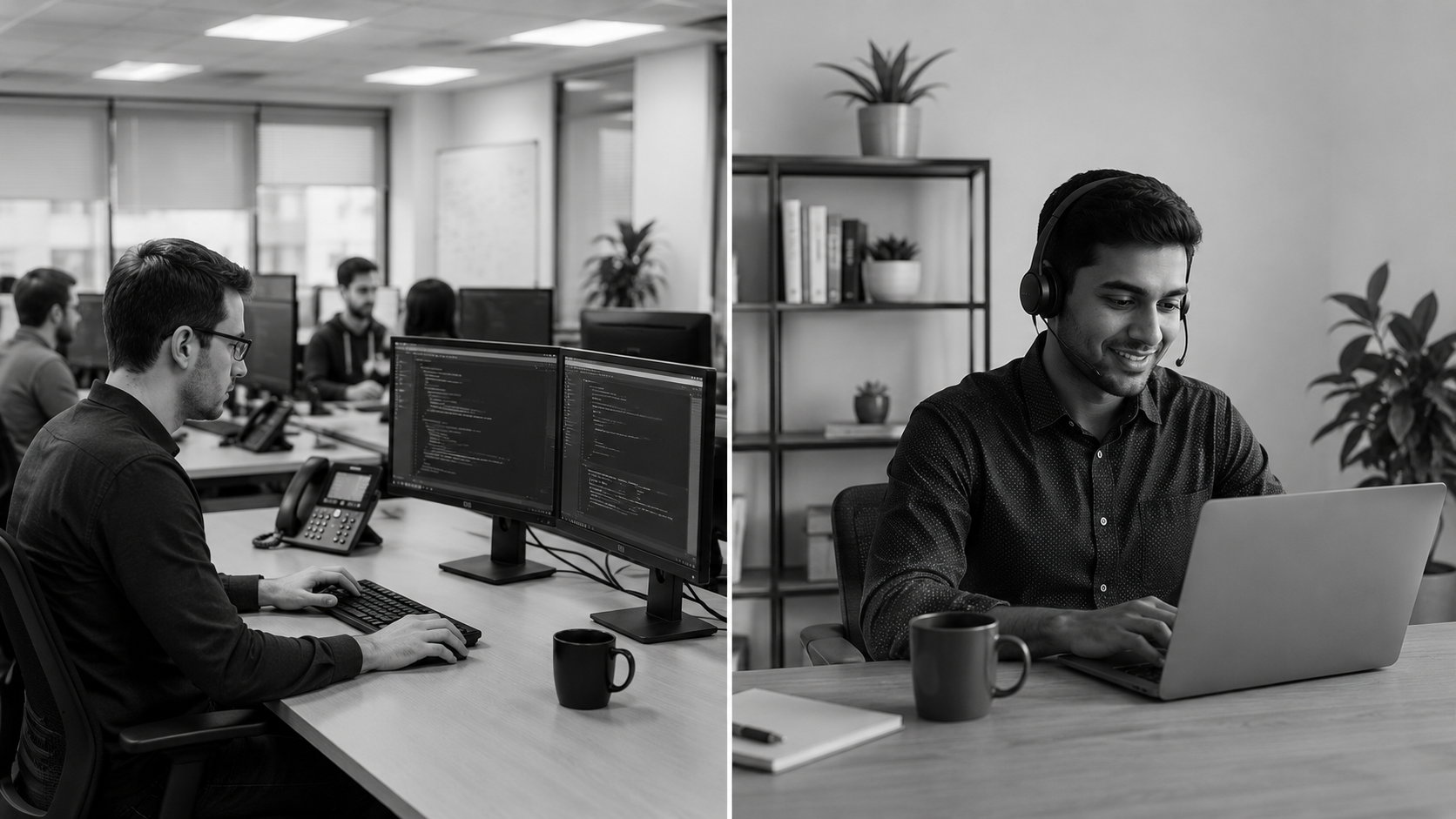
The problem with making this decision on instinct is that both models are more expensive than they appear on one side and more capable than they appear on the other. The local hire is rarely as affordable as the salary offer suggests — the fully loaded cost consistently runs 40–60% above base compensation once statutory obligations, equipment, recruitment, and management overhead are properly accounted for. The offshore remote helpdesk is rarely as limited as the hesitation suggests — when structured correctly, it delivers faster ticket resolution, genuine 24/7 coverage, and stronger retention than the domestic alternative in the same role.
This post runs the honest comparison so the decision is made on complete information rather than incomplete assumptions on both sides.
What In-House IT Actually Costs in 2026
The salary figure on a job offer is the beginning of the in-house cost calculation, not the end. CyberDuo's December 2025 analysis of in-house IT versus outsourced MSP costs frames the comparison correctly: the mistake most companies make is comparing the MSP monthly fee to the IT person's salary, when the correct comparison is the MSP fee to the total cost of employment including all the components that do not appear on the offer letter.
For a US-based L1 or generalist IT support technician in 2026, the salary benchmark sits between $55,000 and $87,000 depending on market and experience level, based on Glassdoor and Indeed compensation data for the role. In major metropolitan markets — Dallas, Chicago, Los Angeles, New York — the upper end of that range is the realistic hiring floor for a competent candidate. The total employment cost picture looks significantly different once the full stack is visible.
Medha Cloud's March 2026 analysis of remote work IT statistics confirms the pattern: companies using managed remote helpdesk services report 42% lower per-device management costs than in-house teams, and MSP-managed teams deliver 67% faster ticket resolution times on average due to 24/7 coverage and standardised tooling. Those figures reflect the structural advantages of a delivery model designed around consistent tooling and coverage rather than a single person's schedule and knowledge base.
The table below builds the true annual cost of a single in-house US IT hire against the equivalent offshore remote helpdesk technician, using documented 2026 benchmarks.
| Cost Component | In-House US IT Hire (USD) | Remote Filipino Helpdesk Technician (USD) |
|---|---|---|
| Base salary / service fee | $55,000–$87,000 | $13,000–$22,000 |
| Payroll taxes (FICA, FUTA, SUTA) | $5,000–$8,500 | $0 |
| Health insurance contribution | $6,000–$12,000 | $0 |
| Equipment and tooling | $2,000–$4,000 | $0 |
| Recruitment cost (annualised over tenure) | $3,500–$8,000 | $0 |
| Onboarding and training time | $2,500–$5,000 | $0 |
| Management overhead | $3,000–$6,000 | $0 |
| Total annual cost (est.) | $77,000–$130,500 | $13,000–$22,000 |
The annual saving on a single technician position runs between $55,000 and $108,500 USD depending on market and experience level. For a small MSP operating on 20–25% net margins, that differential represents the equivalent of $220,000–$434,000 in new annual revenue — without signing a single additional client.
The Capability Comparison That Most MSP Owners Get Wrong
The cost case for remote offshore helpdesk is straightforward once the full employment cost is visible. Where the comparison becomes more interesting — and where most MSP owners have incomplete information — is on the capability side.
The instinct is to assume that in-house is inherently more capable: the local technician knows the clients personally, can go on-site if needed, and is available during business hours for spontaneous collaboration. All of that is true. What is also true is that a single in-house technician is available for approximately 1,760 billable hours per year after accounting for annual leave, sick days, training, and public holidays — and those hours cover a single eight-hour window per day, five days per week. Everything outside that window either falls to the owner or goes unanswered.
A remote Filipino technician working a Manila day shift covers the North American overnight window — approximately 7pm to 4am Eastern on a standard schedule — without any reduction in their own working quality. They are not being woken up. They are not managing an on-call phone. They are doing their job at their desk, in the middle of their working day, at peak cognitive capacity. The 67% faster ticket resolution that Medha Cloud documents for MSP-managed remote workers reflects precisely this dynamic — coverage designed around the ticket's arrival time rather than the technician's preferred sleep schedule.
For Australian MSPs the picture is even cleaner. A Filipino technician on a standard Manila day shift aligns almost perfectly with Australian eastern business hours — no time zone management required, no overnight premium, simply a fully present technician available throughout the client's working day at a fraction of local hiring cost.
The Five Scenarios Where Each Model Wins
Neither model is universally superior. The right choice depends on the specific operational situation the MSP is in. The five scenarios below map which model wins at each stage.
| Scenario | Model That Wins | Reason |
|---|---|---|
| MSP needs regular on-site presence at client locations | In-house local hire | Physical presence cannot be replicated remotely — on-site requirements need a local technician |
| MSP needs overnight and weekend ticket coverage | Remote offshore helpdesk | Local overnight hiring costs 3–4x more and produces lower quality work from exhausted on-call staff |
| MSP is adding clients faster than local hiring can keep pace | Remote offshore helpdesk | 2–4 week offshore onboarding vs 45–90 day local hiring cycle — capacity available when needed |
| MSP needs specialist skills — security, cloud architecture, compliance | In-house or senior offshore hire | L1 offshore model is not the right fit for specialist depth — consider senior offshore or co-managed arrangement |
| MSP owner personally absorbing L1 overflow and overnight tickets | Remote offshore helpdesk | Owner time cost far exceeds offshore service fee — structural relief available immediately |
The first and fourth rows are the honest acknowledgement that remote offshore helpdesk is not the right answer for every situation. On-site requirements need local people. Specialist depth at the L2 and L3 level requires either experienced local hires or senior offshore technicians with the specific credentials and contextual knowledge the engagement demands. The offshore L1 model is the right answer for the category of work that constitutes the majority of MSP ticket volume — and that honest scoping is what makes the model credible rather than oversold.
What Remote Actually Means for Ticket Quality in 2026
The concern about remote helpdesk quality has not disappeared in 2026 — it has become more testable. MSPs that have run remote offshore helpdesk engagements for twelve months or more have real performance data: first response times, first contact resolution rates, CSAT scores, SLA compliance rates. The anecdotal concern about quality has given way to a measurable reality that consistently shows remote offshore helpdesk performing at parity with or above local L1 benchmarks when the engagement is properly structured.
The structural elements that produce quality parity are documented in the Konnect guide on maintaining service quality across time zones — PSA-configured SLA timers, explicit ticket quality standards, tiered escalation matrices, asynchronous handoff documentation, and weekly calibration reviews. These are not extraordinary interventions. They are the same operational disciplines that produce quality in any remote work arrangement, applied consistently to an offshore context. The MSPs who report quality problems with offshore helpdesk almost invariably have documentation and process gaps that would produce the same problems with any technician, local or remote.
The Hybrid Model That Most Growing MSPs End Up With
In practice, the in-house versus remote decision is rarely permanent or binary. The MSPs that use offshore helpdesk most effectively are those that have thought clearly about what each model is good for and structured their team accordingly — local senior technicians handling client relationships, complex escalations, on-site requirements, and strategic advisory; offshore technicians handling the first-response and overnight volume that makes up the majority of ticket count but not the majority of required expertise.
This hybrid structure is what the Konnect guide on scaling your MSP helpdesk without hiring locally describes as the L1 offshore layer — not a replacement for local capability but an addition to it that absorbs the volume that does not require local expertise. The local team gets more of the work that requires their skills. The offshore team gets the high-frequency, well-documented work they can handle independently. The owner gets their overnight hours back and the margin improvement that makes the next phase of growth financially viable.
For MSPs at the stage where that hybrid model is the right next step, the question is not whether remote offshore helpdesk can match in-house quality — the data says it can for the right scope of work. The question is whether the engagement is structured well enough to produce that outcome, which is a documentation, onboarding, and process question rather than a talent question.
If you are an MSP owner working through the in-house versus remote decision right now and want to map it against your specific ticket volume, client profile, and coverage gaps:
📅 Book a 20-minute call: https://meet.brevo.com/konnectph
✉️ Email us: hello@konnect.ph
We will walk through the comparison specific to your operation and give you a straight answer about which model fits where you are right now.
About the Author
Vilbert Fermin is the founder of Konnect, a remote staffing company connecting North American and Australian businesses with top Filipino talent. With deep expertise in IT support and remote team management, Vilbert helps MSPs access skilled technical professionals without the overhead of full-time domestic IT staff. His mission is to showcase Filipino excellence while helping businesses stay protected, productive, and competitive through strategic remote staffing.
Related Resources